
This report is based on the consolidated information gathered by the PEN Belarus monitoring team from open sources, through personal contacts and direct communication with cultural figures. The information reflects the situation at the time of preparation and may be updated as new information becomes available.
Despite measures taken to ensure the accuracy and completeness of the information, the limited availability of public information may leave gaps, including in identifying individuals as cultural figures or determining whether they belong to this category. PEN Belarus welcomes corrections or any additional information you may wish to share. If you would like to report a violation (including confidentially) or clarify details in this report, please get in touch with us at [email protected] or t.me/viadoma.
Given the situation in Belarus’s cultural sector, the role of cultural figures in public life and the importance of creative work for the preservation and development of cultural rights, we recognise Belarusian cultural figures as defenders of cultural rights, in accordance with the approach set out in the 2020 report of the UN Special Rapporteur in the field of cultural rights (A/HRC/43/50). Further information about the monitoring is available here.
Key findings
Conditions of detention of cultural figures in places of incarceration
Arbitrary detentions, criminal prosecution and sentencing of cultural figures
Releases through pardons and deportations of cultural figures
Criminalisation of independent culture
Persecution of businesses promoting Belarusian culture and national symbols
Control and ‘invisible repression’ in the cultural sector. Censorship and expansion of the list of ‘extremist materials’
Transnational repression
State policy in the cultural sector
Conclusions
Disclaimer: Belarusian personal names and proper names
KEY FINDINGS
Since 2020 – for more than six years now – businessman and cultural manager Eduard Babaryka, anarchist and writer Alaksandr Franckievič, architect Rascisłaŭ Stefanovič, artist Ivan Viarbicki, and anarchist and writer Ihar Alinievič have remained behind bars.
As of 30 September 2026, at least [1] 65 cultural figures remained imprisoned in politically motivated cases, while a further 50 representatives of the sector were serving sentences involving restrictions on freedom without placement in an open-type correctional facility (‘home confinement’). In total, at least 115 cultural figures, including 19 writers, were deprived of or had their freedom restricted.
Between January and September 2026, at least 31 cultural figures were released through pardons. Some were allowed to remain in Belarus, while one in three of those released was deported from the country. These pardons do not amount to the restoration of justice or the rehabilitation of victims. Repression against cultural figures, organisations and other participants in cultural life continued throughout the reporting period, including arrests, ill-treatment in detention, arbitrary sentencing, searches at border crossings, defamation, transnational persecution of cultural figures in exile, and the broader criminalisation of cultural activity both within Belarus and abroad.
Repression occurs in recurring waves. While 2021 was marked, among other things, by the detention of independent publishers and the mass closure of commercial shops selling products featuring Belarusian national symbols, both sectors came under attack again in 2026, facing unprecedented pressure and targeted persecution.
Politically motivated criminal prosecution, violations of the right to a fair trial and arbitrary detention of cultural figures remain the principal violations committed by the Belarusian regime against representatives of the cultural sector.
The following developments were documented in the last three months alone:
- Artist Aksana Šalapina, who is serving a three-year sentence for helping political prisoners, was diagnosed with cancer. Artist Ivan Viarbicki has been held incommunicado for almost three years. Cultural studies scholar Vacłaŭ Areška has almost completely lost his sight in prison.
- Musician Jahor Ciuškievič and photographer Vadzim Zdaraviennaŭ, both already serving sentences, were convicted again.
- Musician Aleś Čumakoŭ was convicted directly for his cultural activities, having allegedly ‘played Belarusian folk music and thereby brought together the core of the protest movement’. Siarhiej Sałaš and Dzmitryj Babicki each received five-year prison sentences in the case involving the Skład Butelek art space in Barysaŭ.
- Alongside the detention of people allegedly linked to the Belarusian Council for Culture and other organisations abroad, law enforcement agencies continued searching for evidence of ‘Western funding’ inside Belarus and pursuing further persecution in the European Humanities University case.
- Film director Andrej Kudzinienka was subjected to interrogations and searches lasting 15 hours, after which he urgently left the country.
- One of Belarus’s first independent publishing houses, Technalohija, founded in 1988, was designated an ‘extremist organisation’.
- The popular clothing brands Honar and LSTR, as well as the Ragna ethnic goods shop, were forced to close.
- The authorities cancelled the annual medieval culture and music festival Our Grünwald, held in Belarus since 2008.
‘We’ll sweep away all this nationalist infection with a filthy broom! […] We’ll root it out completely […] What’s more, it won’t end with either Ragna or this Grünwald […] And believe me, just as Knihaŭka [2] was once simply wiped out, so it will continue,’ said Vadzim Hihin, Director General of the National Library of Belarus, historian and propagandist.
Persecution over donations continues, including the initiation of criminal cases and the practice of ‘voluntary donations’, whereby individuals are required to transfer large sums of money to the bank accounts of state organisations in exchange for the suspension of criminal proceedings concerning earlier donations to victims of repression. Other ongoing practices include searches at border crossings, sometimes involving complete strip searches; extrajudicial forms of persecution, such as summonses as witnesses, interrogations, threats and searches; the use of ‘blacklists’ to exclude cultural figures from public life; and professional bans.
Transnational persecution of cultural figures in exile also continues, taking the form of convictions in absentia, confiscation of property, searches and visits to relatives, digital harassment, and insults and degrading treatment in state-controlled and propagandist media, including attacks on cultural figures who have died in exile.
Dozens of cultural figures have been added to an international wanted database shared with the Russian Federation, indicating that criminal cases have been opened against them in Belarus. Among them is Nobel laureate Aleś Bialacki, who was released through a pardon on 13 December 2025.
All categories of lists used to persecute cultural figures, organisations and cultural products have expanded: lists of ‘extremists’, ‘terrorists’, ‘extremist formations/organisations’, ‘extremist materials’, and books deemed ‘capable of harming the interests of the Republic of Belarus’.
Among developments in state cultural policy, a government resolution abolished the National Centre for Contemporary Arts, which celebrated its tenth anniversary last year. Local authorities were instructed to prepare the necessary documents to remove architectural monuments deemed ‘unnecessary to the state’ from the State List of Historical and Cultural Values of the Republic of Belarus.
Persecution between January and September 2026 in figures:
- 1,040 violations of cultural rights and human rights of cultural figures were documented.
- As of 30 September 2026, there were 876 political prisoners in Belarus, including at least 55 cultural figures. Between January and September 2026, human rights defenders recognised at least 22 cultural figures as political prisoners.
- In total, at least 115 representatives of the cultural sector, including 19 writers, were imprisoned in penal colonies, prisons or pre-trial detention centres, held in open-type correctional facilities (‘khimiya’), or serving sentences under ‘home confinement’ on politically motivated grounds.
- The most common form of repression during the reporting period was the designation of culturally themed materials and cultural figures’ social media accounts as ‘extremist materials’ (302 cases). Censorship ranked second (133 cases, including 33 additions to the list of printed publications banned from distribution in Belarus). Third were violations relating to the improper treatment of cultural heritage (82 cases), followed by violations of the right to a fair trial or lack of access to justice (71 cases).
- At least 49 cultural figures were subjected to arbitrary detention or arrest (one female artist was detained twice). Administrative persecution of 14 individuals is known to have occurred, with 22 administrative offence reports drawn up.
- At least 68 cultural figures inside Belarus and in exile faced criminal prosecution. At least 30 representatives of the sector were convicted in criminal proceedings, including three in absentia.
- At least 24 cultural figures were placed on international wanted lists by the Belarusian authorities.
- Thirteen representatives of the sector were forcibly expelled or deported from the country.
- 27 cultural figures were added to the ‘List of Citizens Involved in Extremist Activities’. At least 59 individuals were added to lists of alleged members of ‘extremist formations’ (publisher Andrej Januškievič was listed twice).
- Seven cultural and educational institutions or public associations were liquidated. 15 cultural and educational organisations and initiatives operating abroad were designated ‘extremist formations’, while another two were labelled ‘extremist organisations’, including Technałohija, one of Belarus’s oldest independent publishing houses.
- The Ministry of Information added 33 books – works of fiction, historical publications and books containing analytical material – to the ‘National List of Extremist Materials’. Another 33 titles were added to the list of printed publications whose distribution is deemed ‘capable of harming national security’. In total, a further 66 books by Belarusian and foreign authors were officially banned in Belarus.
CONDITIONS OF DETENTION OF CULTURAL FIGURES IN PLACES OF INCARCERATION
The conditions in which political prisoners who are cultural figures are held, and their treatment by prison administrations, continue to fall short of minimum human rights standards, with no improvement in sight. Imprisonment is accompanied by systematic pressure, persecution, inadequate or delayed medical care, and prolonged isolation.
Artist Ivan Viarbicki, sentenced to 10 years and one month in prison, has been behind bars since October 2020. He faces severe pressure from the prison administration and has been held incommunicado for the past three years, since August 2023.
Anarchist and writer Ihar Alinievič, sentenced to 20 years’ imprisonment, is also being held in extremely difficult conditions. He has been imprisoned since late October 2020 and is currently held in a cell-type facility (PKT). For six years, he has been completely deprived of visits, telephone calls, medical and personal parcels, and money transfers. Like Ivan Viarbicki, Ihar is regularly placed in a punishment cell (SHIZO).
Conditions of detention have caused serious health problems for many imprisoned cultural figures.
For example, camera operator Jaŭhien Hłuškoŭ was released in August this year after serving more than two and a half years. Immediately after his release, he had to seek medical assistance and was urgently hospitalised because of a trophic ulcer on his leg.
Artist Aksana Šalapina, who has been imprisoned since June 2025, has been diagnosed with cancer. She now spends most of her time in the penal colony’s medical unit.
A person familiar with the situation described the health of journalist and science-fiction writer Siarhiej Sacuk, who has been behind bars for almost five years:
‘He has serious health problems. As for his heart, the doctor said he needs a pacemaker, and without one every day is like a lottery. But no one in the penal colony is going to provide that. He also has serious problems with his pancreas and spine, and they won’t allow all the medicines he needs to be sent to him. Things are very difficult for him.’
The sharp deterioration in the health of political prisoner, journalist and non-fiction writer Ihar Iljaš, who has been behind bars for two years, was reported by his wife, former political prisoner Kaciaryna Andrejeva:
‘After coming out of the punishment cell, Ihar immediately began complaining about swelling: his legs and hands were swollen. After the punishment cell, he was sent to work processing rubber, tyres for example. That also had a very bad effect on his health: he began experiencing problems with coordination, particularly in his right hand. And when he last came out of the punishment cell, people noticed that he was limping. Add to that the fact that his eyesight deteriorated sharply because of his time in the punishment cell.’
Aleś Čumakoŭ reported that street artist Aleh Łaryčaŭ also has serious health problems:
‘They brought him to my trial as a witness. He didn’t look well.’
It is also known that political prisoner and musician Aleh Chamienka is experiencing health problems.
The health of 71-year-old trade union activist and cultural studies scholar Vacłaŭ Areška, who has been behind bars for four and a half years, is a matter of particular concern. Former political prisoner Dzmitryj Siemčanka, who served his sentence in the same penal colony as Areška, said that when the scholar began losing his sight, no one was able to help him:
‘His retina, as it’s called, became detached, and things kept getting worse and worse. We had to guide him to make a phone call; we literally had to guide him to the kitchen. He can walk, but he can’t see anything.’
Throughout his imprisonment, Vacłaŭ Areška has been completely denied visits from relatives.
Musician Aleś Čumakoŭ‘s account offers an insight into the nature of Belarus’s penitentiary system and its treatment of people persecuted on political grounds. After his release, he shared details of the torture he endured during the investigation and imprisonment. This is just one example:
‘One of them [a KGB officer] had special reinforced boots, some kind of combat boots designed specifically for this procedure (none of the others wore anything like them). He beat me all the way from the Investigative Committee to Akrescina. Every three to five seconds, I was struck on the head: from behind, from the front, from above. And throughout that time, they weren’t just beating me; they were also threatening to rape me. Then he started kicking me. The entire right side of my body – my leg, side and arm – was covered in bruises. One kick from a reinforced boot landed directly on my elbow. My central nerve stopped functioning, and two of my fingers simply went numb. Sensation only returned after four months. In the pre-trial detention centre, I couldn’t hold a pen or even pick up backgammon dice – they kept falling out of my hands.’
After the beating and torture, Aleś was taken to the temporary detention facility on Akrescina Street, where he was held in an overcrowded punishment cell with insanitary conditions and no possibility of normal sleep. Before being transferred to the pre-trial detention centre, he did not recognise himself in the mirror because his face had turned completely green.
ARBITRARY DETENTIONS, CRIMINAL PROSECUTION AND SENTENCING OF CULTURAL FIGURES
ARBITRARY DETENTIONS
Between January and September 2026, at least 49 cultural figures and cultural sector workers were subjected to arbitrary detention or arrest (one person twice).
In February and March, mass detentions took place among publishers, book distributors and writers: at least 10 people were detained, some of whom were sentenced to 14–15 days of administrative detention (most commonly under Article 24.3 of the Code of Administrative Offences, for alleged ‘failure to comply with a lawful order’). The grounds for persecution were the publication and distribution of Belarusian books. Translator and publisher Zmicier Kołas, one of those arbitrarily arrested in the case involving booksellers, ultimately spent seven months in pre-trial detention (facing charges under Article 361-4 of the Criminal Code) before being included, on 16 September, among 25 political prisoners pardoned and deported from Belarus.
In mid-July this year, activist and promoter of Belarusian culture Nina Bahinskaja was once again detained without justification on the street. It is known that law enforcement officers searched her personal belongings without providing any explanation and confiscated a book (title unknown) from her bag.
On 22 July, OMON riot police and the KGB came to film director Andrej Kudzinienka. Eight OMON officers and two KGB officers took part in searches of his flat and the KinaKałajdar film school, which lasted 15 hours. Kudzinienka’s passport and telephone were confiscated (all his messaging applications and social media accounts are under KGB control). Following interrogations and threats of eight to twelve years’ imprisonment, Kudzinienka was released and subsequently managed to leave Belarus. For further details of this persecution, see the section of this report on the criminalisation of independent culture.
CRIMINAL PROSECUTION
At least 68 cultural figures, both within Belarus and in exile, are known to have faced criminal prosecution. In the case of those in exile, the opening of criminal proceedings against them sometimes only becomes known when their names appear in the Russian Federation’s wanted persons database, to which they are added at the request of the Belarusian Ministry of Internal Affairs. Between January and September 2026, more than two dozen cultural figures were added to this database, including Kaciaryna Vadanosava, Siarhiej Mieljaniec, Pavieł Mažejka, Aleś Bialacki, Jan Hardziejeŭ, Ihar Klaščuk, Nadzieja Zielankova, Darja Žuk, Alena Makoŭskaja, Nina Šydłoŭskaja, Alaksandr Ždanovič, Siarhiej Padsasonny, Rusłan Kulevič and several others.
Cultural manager and director of the Minsk creative space Parason, Inha Kaziučyc, who was detained at home on 10 February, remains in pre-trial detention in a politically motivated criminal case. It is known that the initial grounds for her detention were proceedings under Article 130 of the Criminal Code (‘Incitement of hatred or enmity’). Charges under Part 1 of Article 367 (‘Defamation of Łukašenka’), Part 2 of Article 368 (‘Insulting Łukašenka’) and Part 1 of Article 361-4 (‘Facilitating extremist activity’) were subsequently added. The Parason art space hosted lectures, courses and workshops on various aspects of Belarusian culture, predominantly traditional culture. Its activities were constantly monitored, with ‘observers’ attending events. Some lectures provoked particularly strong reactions: in 2025, for example, an evening commemorating Belarusian poet Łarysa Hienijuš was cancelled following fierce criticism from pro-government Telegram channels. The space has now ceased operating.
In late April, as part of a criminal case involving the Belarusian Council for Culture [which was designated an ‘extremist formation’ in Belarus for the second time on 9 April 2026], activists from Słonim who promote Belarusian culture and local history – Aleś Masiuk, Pavieł Sievasćjan and Viktar Marčyk – were detained. They had participated in some cultural meetings and remain behind bars. The imprisonment of other cultural figures is also known.
CRIMINAL SENTENCES
At least 30 cultural figures (three of them in absentia) were held criminally liable in politically motivated cases between January and September 2026.
Among the cultural figures arbitrarily sentenced in the third quarter was bard, translator, multi-instrumentalist and vocalist Aleś Čumakoŭ, one of the 25 people pardoned and deported on 16 September 2026. In August, the musician was convicted under Article 361-1 of the Criminal Code for alleged involvement in the Belarusian Council for Culture, although he had no connection with the organisation. An album of Belarusian songs featured in his case (the songs were even played during the trial), and accusations were made along the lines that he had ‘played Belarusian folk music and thereby brought together the core of the protest movement’. Aleś Čumakoŭ was sentenced to two years in a penal colony for his creative work. He was released from the pre-trial detention centre, where he had been awaiting the outcome of his appeal.
On 9 September, lawyer and musician Dzmitryj Łajeŭski was sentenced to three years’ imprisonment and taken into custody in the courtroom. The criminal case had been opened in August 2025, when Łajeŭski was detained, although he remained at liberty during the investigation. In 2020–2021, Dzmitryj Łajeŭski represented politician and philanthropist Viktar Babaryka, as well as lawyer and writer Maksim Znak. After Babaryka’s conviction, he was disbarred. The final indictment comprised nine episodes: interviews with various independent Belarusian media outlets, mostly given before 2021, in which Łajeŭski commented on criminal cases against his clients, his disbarment and the persecution of lawyers in Belarus more broadly.
On 14 September, the verdict was announced in the case involving the Skład Butelek (‘Bottle Warehouse’) art space in Barysaŭ, which the KGB had designated an ‘extremist formation’ in November 2025. Siarhiej Sałaš and Dzmitryj Babicki, who were alleged to have been involved in the space’s activities, were each sentenced to five years in a penal colony and substantial fines.
‘Just think how much good they did, how many exhibitions, film screenings, concerts and meetings for young people they organised! The state doesn’t do anything like as much for people; indeed, it actually tries to prevent such things, to stop people coming together, to stop more than three people gathering,’ said a former political prisoner who encountered them in detention.
On 29 September, political prisoner and photographer Vadzim Zdaraviennaŭ, who was serving a sentence in a penal colony and was due to be released in November 2026, was convicted in a second criminal case. According to available information, the grounds for his prosecution were comments and photographs subsequently discovered on his laptop. His combined sentence was four years and seven months in a penal colony and a fine.
Among the cultural figures sentenced between January and September 2026 were: journalist and non-fiction writer Cina Pałynskaja (charged under Article 361-1 of the Criminal Code; sentenced to two years in a penal colony and a fine); musician, researcher and leader of the folk-modern band Pałac, Aleh Chamienka (Article 361-4; three years in a penal colony and a fine exceeding BYN 20,000 / approximately USD 7,000); Jahor Bužyłaŭ, one of the managers of the Bielaruskicry jewellery brand (Article 361-1; four years of restricted freedom in an open-type correctional facility, ‘khimiya’); craftswoman Iryna Jakaŭleva, who worked in ecclesiastical art (Article 357; eight and a half years in a penal colony and a fine of BYN 45,000 / approximately USD 16,000); Viktar Jaŭmienienka, chair of the Vacłaŭ Łastoŭski Society of History Enthusiasts (Article 361; penal colony); Jahor Ciuškievič, a musician and employee of the Brest Puppet Theatre (article and sentence unknown; second trial); drummer Cimafiej Puhačoŭ (Article 361-4; three years in a penal colony); musician Uładzimir Patapienka (Articles 361-4 and 328; ‘home confinement’; pardoned on 20 March 2026); wildlife photographer Natalla Bačurynskaja (Article 361-4; following an appeal, a sentence of three years in a penal colony and a BYN 22,500 / approximately USD 8,000 fine was replaced with three years of ‘home confinement’); designer Jana Syrevič (Article 361-4; ‘home confinement’); historian and tour guide Michaił Masalevič (Article 361-4; three years of ‘home confinement’); Natalla Dziadziula, an employee of Belarusian State University of Culture and Arts (Articles 130 and 361-4; ‘home confinement’); designer and illustrator Jana Maskalova (Article 361-4; ‘home confinement’); Kirył Łojka, a member of the ChurchBrass brass band (Article 361-4; ‘home confinement’); vocalist and singing teacher Sviatłana Karalova (Article 361-4; ‘home confinement’); journalist and local historian Alaksandr Lubiančuk (Articles 361-4 and 130; one year in a penal colony – of a four-year sentence, three years were credited as time already served under an earlier sentence; released on 12 May 2026 after serving his sentence); businessman and former chair of the Spadčyna Palessia public association Alaksandr Baranaŭ (Article 361-4; three years in an open-type correctional facility, ‘khimiya’; emigrated after sentencing); Ihar Svirydzienka, former head of the Pamiać Ajčyny association (Article 361-4; exact sentence unknown – either a penal colony or ‘khimiya’); comedian Vasil Kraŭčuk (Article 369; ‘home confinement’; second sentence; he was detained in Russia while on an interstate wanted list and extradited, then emigrated following sentencing); bard, translator and multi-instrumentalist Aleś Čumakoŭ (Article 361-1; two years in a penal colony; pardoned and deported on 16 September 2026); history teachers Kaciaryna Žohal and Volha Vostrykava (Article 361-4; ‘home confinement’); Sviatłana Dzieŭdziera, an editor at the Adukacyja i Vychavannie publishing house (Article 361-4; ‘home confinement’); lawyer and musician Dzmitryj Łajeŭski (Articles 361-4 and 369-1; three years in a penal colony); promoters of Belarusian culture Siarhiej Sałaš and Dzmitryj Babicki (five years in a penal colony and a fine of BYN 36,000 / approximately USD 12,000 each); and photographer Vadzim Zdaraviennaŭ (Articles 342, 130 and 203-1; a combined sentence of four years and seven months in a penal colony and a fine of BYN 22,500 / approximately USD 8,000; second sentence).
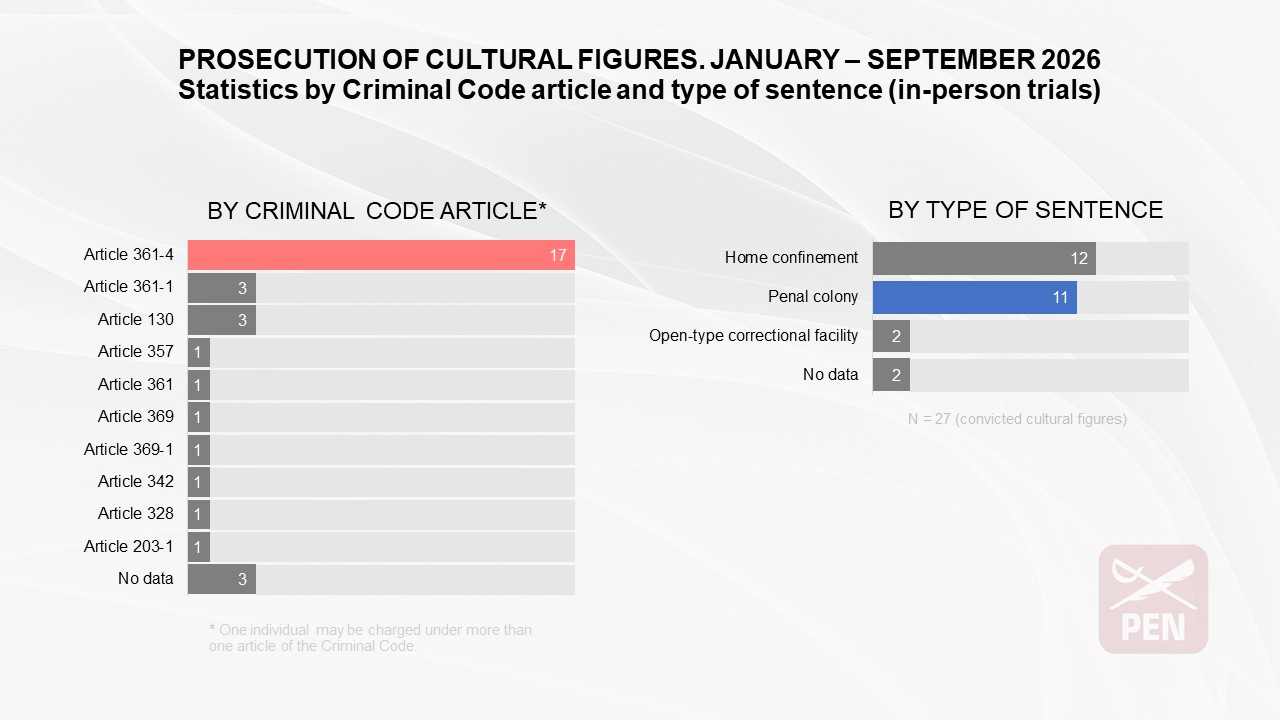
Top three Criminal Code articles used in politically motivated criminal prosecution of cultural figures in Belarus (in-person proceedings):
- Article 361-4 of the Criminal Code (‘Facilitating extremist activity’) – at least 17 of 27 people;
- Article 361-1 of the Criminal Code (‘Creating or participating in an extremist formation’) – at least three people;
- Article 130 of the Criminal Code (‘Incitement of hatred or enmity’) – at least three people.
In almost every second case, cultural figures were sentenced to imprisonment in a penal colony (at least 11 of the 27 people).
Sentences in absentia
Under the special judicial proceedings procedure:
- On 27 July, cultural manager and head of the Okno na Wschód foundation Pavieł Mickievič, who has lived in Poland for more than twenty years, was sentenced in absentia to five years in a penal colony and a substantial fine. He was charged under Articles 361-4 of the Criminal Code (‘Facilitating extremist activity’) and 369-1 (‘Discrediting Belarus’);
- On 4 August, musician Siarhiej Michałok, founder and frontman of the bands Liapis Trubieckoj and Brutto, who lives in Ukraine, was sentenced in absentia to four years in a penal colony. He was charged under Articles 130 of the Criminal Code (‘Incitement of hatred or enmity’) and 368 (‘Insulting the President’);
- On 14 August, a sentence of imprisonment in a penal colony was handed down in absentia against Kaciaryna Mankievič, vocalist of the band Dymna Lotva, who now lives in Poland. She was charged under five articles of the Criminal Code: 289-1 (‘Propaganda of terrorism’), 290-1 (‘Financing terrorist activities’), 361-4 (‘Facilitating extremist activity’), 366 (‘Violence or threats against an official’) and 368 (‘Insulting the President’).
According to Kaciaryna, the grounds for the last charge were a voodoo doll bearing Łukašenka’s likeness that she made for her first free concert after arriving in Warsaw. The activity was organised to recoup money spent on equipment: audience members could stick pins into the doll free of charge, but the pins themselves were available in exchange for any donation to a collection box, enabling the musicians to raise a substantial amount of money.
The names of all three cultural figures convicted in absentia were added to the so-called list of extremists maintained by the Belarusian Ministry of Internal Affairs. Kaciaryna Mankievič was also added to the KGB’s list of ‘terrorists’.
RELEASES THROUGH PARDONS AND DEPORTATIONS OF CULTURAL FIGURES
Between January and September 2026, a series of pardons took place in Belarus, resulting in the release of at least [3] 31 cultural figures, 12 of whom were immediately deported from the country.
The 23 cultural figures released during the first quarter of 2026 are listed in the quarterly monitoring report. On 28 April, as part of a prisoner exchange between Belarus/Russia and Poland, Andrzej Poczobut, a journalist, poet and member of the Union of Poles in Belarus, was released after spending more than five years behind bars.
On 16 September, during the latest visit to Minsk by John Coale, the US President’s Special Envoy for Belarus, 25 people were pardoned in exchange for the United States lifting sanctions against two Belarusian enterprises. Seven of them were cultural figures, all of whom were deported to Lithuania. Media manager and poet Andrej Alaksandraŭ was released after more than five and a half years in prison for helping participants in peaceful protests; cultural manager and entrepreneur Pavieł Biełavus, co-founder of the independent Art Siadziba venue and creator of Symbal.by, a shop selling national symbols and souvenirs, was released after nearly five years; the musicians of Tor Band, Jaŭhien Burła, Zmicier Hałavač and Andrej Jaremčyk, who had spent almost four years imprisoned for their creative work, were also released; as were bard, translator and multi-instrumentalist Aleś Čumakoŭ, likewise convicted for performing Belarusian songs, and translator Zmicier Kołas, director of the eponymous publishing house whose licence had been revoked in Belarus (the latter two cultural figures had spent nine and seven months behind bars, respectively).
As with previous pardons, those deported received no official documents confirming their release.
It is important to understand that pardons do not signify an end to repression in Belarus. As human rights defender and writer Aleś Bialacki notes, releasing political prisoners in exchange for sanctions relief does not affect the foundations of Belarus’s political system or alter the fundamental nature of the regime. The persecution of dissenters and the level of repression in the country are not declining: between January and September 2026, 31 cultural figures were pardoned, but during the same period at least 49 cultural sector workers were arrested or detained and 22 representatives of the sector were recognised as political prisoners. Those pardoned are themselves subjected to further persecution: new criminal cases are opened against them, their social media accounts are designated ‘extremist’, searches are conducted at their registered addresses, and former political prisoners are placed on wanted lists – as happened to Bialacki himself, who was pardoned and deported on 13 December 2025.
CRIMINALISATION OF INDEPENDENT CULTURE
The state is criminalising independent culture on both sides of the border – both through the mass designation of organisations and initiatives as ‘extremist’ and through direct violence and the forced closure of projects inside Belarus, where even the word ‘independent’ is perceived by the authorities as a threat.
DESIGNATION OF CULTURAL ORGANISATIONS AS ‘EXTREMIST’
Between January and September 2026, 15 Belarusian organisations in the cultural (and educational) sector that operate legally abroad were designated ‘extremist formations’ by the Belarusian KGB or Ministry of Internal Affairs. These included the Budźma biełarusami! (‘Let’s Be Belarusians!’) cultural and educational campaign; Belarusian PEN, a literary and human rights organisation; the independent Belarusian publishing houses Gutenberg Publisher, Lohvinau and Yanushkevich; the Belarusian online library and publishing house of the Kamunikat Foundation; Spadčyna Biełarusi, a cultural and educational initiative in Wrocław; the Northern Lights film festival; Brama Spadčyny, an initiative to preserve the shared cultural and historical heritage of Belarus and Poland; the Belarusian Council for Culture, a community of experts, managers and creative professionals (and its individual projects Magistrat, Vaśminoh and ArtPower Belarus); the Znivien Belarusian clothing and merchandise brand; the Belarusian showroom and online shop The Krama Store and marketplace for Belarusian goods Kamaroŭka; the online language school LVS. Language School; and the satirical project ČinČinČenel.
In addition, the European Humanities University (EHU) in Vilnius, Lithuania, was granted the status of an ‘extremist organisation’ by a decision of the Supreme Court of the Republic of Belarus, and the independent publishing house Technałohija was given the same designation by the Economic Court of Minsk.

PERSECUTION OF ANDREJ KUDZINIENKA AND THE PRIVATE KINAKAŁAJDAR FILM SCHOOL [4]
The persecution of director Andrej Kudzinienka and the destruction of the KinaKałajdar film school vividly demonstrate how the system can destroy an independent cultural space in a single day, with repressive pressure accompanied by a whole range of gross human rights violations.
Visionary Belarusian film director Andrej Kudzinienka (whose film Occupation. Mysteries ranks second among the 50 greatest Belarusian films of all time according to the Belarusian Independent Film Academy, BIFA) was forced to leave Belarus in late July 2026 following severe pressure from the security services. The persecution began immediately after Kudzinienka re-registered the private KinaKałajdar film school in his own name. The school had been operating in Minsk for about three years, teaching directing, acting and animation.
On the morning of 22 July, eight OMON riot police officers and two KGB officers forcibly stormed the director’s premises. They advanced with shields, shining lights into his eyes and shouting, ‘On the floor! Get down on the floor!’ Kudzinienka did not fall to the floor, so they shoved him down and began a thorough search.
‘I was handcuffed. They wouldn’t let me take my medication or drink any water, and for a long time they wouldn’t let me go to the toilet,’ Kudzinienka recalls.
The security officers were looking for ‘financing of extremist activities’, claiming, ‘Well, you know, you take money from the West.’ Their objections to the film school included, for example, attempts to apply for grants from UNESCO funds and the American Sundance Film Festival. When Kudzinienka asked why the world’s best-known festival for debut films was considered ‘extremist’, the response was, ‘Well, it’s independent cinema,’ with the additional assertion that any funding not controlled by the state amounted to ‘extremism’.
After searching the flat, the security officers left neither documents nor copies of the search reports. They confiscated money, examined the director’s telephone and questioned him about his contacts (some of the people in his address book were subsequently also subjected to unjustified searches). The search and interrogation, accompanied by constant psychological pressure, then continued at the film school’s office, where the organisation’s former director was also brought. There were mocking remarks about alleged money from Siarhiej Budkin [5], references to the Belarusian Independent Film Academy and other non-state cultural initiatives in exile.
Having found neither ‘extremist documents’ nor prohibited [white-red-white] symbols, the KGB officers threatened Kudzinienka with eight to twelve years’ imprisonment, citing provisions concerning fraud and extortion. They confiscated all the company’s documents and, as for its future work, declared, ‘The operation is shut down!’
PERSECUTION OF BUSINESSES PROMOTING BELARUSIAN CULTURE AND NATIONAL SYMBOLS
In the third quarter of 2026, several Belarusian-oriented businesses that had operated in the country for more than ten years were forced to close.
On 8 July, Honar, a designer clothing and accessories brand featuring Belarusian motifs, founded in Minsk in 2013 by the married couple Pavieł Doŭnar and Karyna Adziesienka, announced its imminent closure in an Instagram story: ‘Friends, we have an update. The honar.by shop will operate until 19 July. After that, we will cease trading. Thank you for being with Honar.’
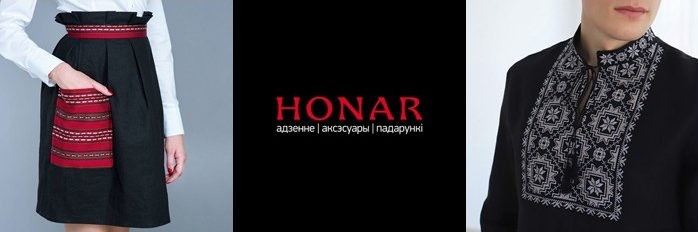
On 10 July, it emerged that Ragna, an ethnic goods shop in Belarus that had operated in central Minsk since the summer of 2013 and sold products by Belarusian craftspeople, was closing. ‘Our shop is closing. But you still have an opportunity to buy your favourite products from our online shop at ragna.by,’ the organisation announced on Threads.
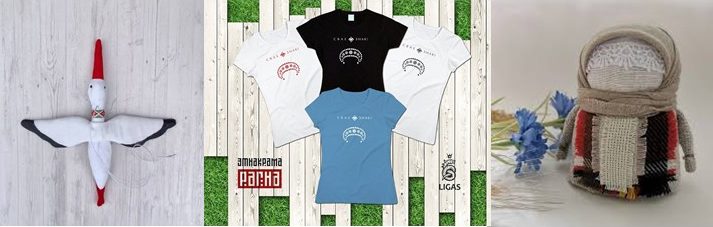
On 13 July, another Belarusian clothing and souvenir brand, LSTR Adzieńnie, announced its closure. Founded by Ilja Aksionaŭ in 2011, the project produced clothing and souvenirs featuring Belarusian national motifs. ‘Dear friends! Our brand is ceasing operations. We sincerely thank you for being with us all this time, for your trust and support!’ the team announced in an Instagram story.
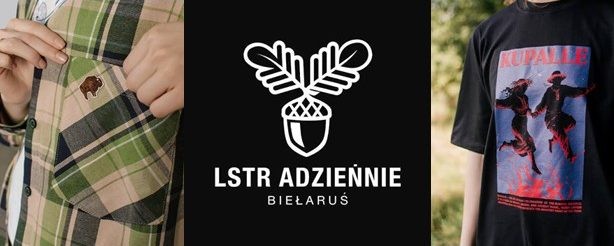
The reasons for the closures were not officially disclosed. However, the following day, 14 July, the Viasna Human Rights Centre reported that the closures of Honar, Ragna and LSTR Adzieńnie had been preceded by the detention and interrogation of one of the owners of these brands.
In a livestream with MP Vadzim Hihin, propagandist Hryhoryj Azaronak commented on the closure of shops selling Belarusian national symbols as follows:
‘They’re shouting that it’s all “poverty, decline, they’ve cancelled everything, removed everything, nothing we loved will remain”. Well, that’s precisely because you loved it! Because I know why. Because all these organisations – some selling clothes, some selling something else – are your disguised “waiters”, keeping their true intentions hidden. They send their own people these little signals, these knowing winks: “We’re here, we’re nearby, here, take a T-shirt, it supposedly means nothing at all […] I don’t mind sitting and watching what’s being sold where, and which poetesses are planning to perform where.”’
On 5 May 2026, two months before the closure of Honar, Ragna and LSTR Adzieńnie, two other brands operating in exile – Znivien and The Krama Store – were designated ‘extremist formations’ by the Belarusian KGB. Znivien is a Belarusian clothing and merchandise brand founded in Poland in 2021 by Uładzimir Malaŭka and Pavieł Dzierkač. The Krama Store is a Belarusian showroom and online shop established in Poland, specialising in clothing, accessories and souvenirs featuring national motifs.
On 8 July, Kamaroŭka, a ‘specialised international marketplace for Belarusian and Belarusian-themed goods in various categories’, registered in Germany and selling books, clothing, home décor and other products, was designated an ‘extremist formation’.
The websites, YouTube channels and/or social media pages of the brands listed as so-called formations are included in the list of ‘extremist materials’: Znivien (website, Facebook, Threads, Instagram and logo [6]), The Krama Store (Instagram), and Kamaroŭka (website, YouTube, Facebook, X, Instagram, LinkedIn and TikTok). This makes accessing them dangerous for users in Belarus.
Other social media accounts belonging to projects associated with Belarusian national symbols were added to the list of ‘extremist materials’ during the reporting period, including:
- Symbolika Batumi (Telegram account),
- Šufliadka (Facebook and Instagram),
- shop (Instagram),
- kramapahonia (Threads),
- Pavetra (Instagram).
Persecution of shops selling national symbols before 2026
The persecution, including that of Honar and LSTR Adzieńnie, which the authorities forced to close, did not begin in 2026. Problems for commercial organisations whose businesses focused on national symbols and souvenirs generally began in 2020, amid the protest movement and growing public interest in historical symbols. Pavieł Biełavus, founder of the Symbal.by shop, said: ‘They’ve been constantly trying to rein us in since the summer [of 2020].’ Even then, customs authorities were refusing to allow parcels containing flags and other symbols through. Biełavus himself was detained on 15 November 2021. On 11 May 2023, he was sentenced to 13 years’ imprisonment and a substantial fine for his cultural activities, including work relating to national symbols. He was released through a pardon on 16 September 2026 after spending almost five years behind bars and was deported from Belarus.
As early as 2021, administrative obstacles to the operation of commercially run shops promoting Belarusian national identity were documented throughout the country [as we reported in our final material for 2021]. These included Kniaź Vitaŭt, Symbal.by, Roskvit, Moj modny kut, Vokladki, BČB.bieł, Admetnasć, Cudoŭnaja krama, Chamieleon, LSTR Adzieńnie, majsternia moj rodny kut and the Honar designer clothing brand. Inspections of these shops began in early 2021, and in some cases inspectors continued visiting until the middle of the year. Shops and/or their owners received inspections, searches or summonses for questioning from officials of the Ministry of Emergency Situations (MES), the Department of Financial Investigations (DFI), the Department for Combating Economic Crimes, the Main Directorate for Combating Organised Crime and Corruption (GUBAZiK), the police, the Special Purpose Police Unit (OMON), the labour inspectorate, the State Committee for Standardisation, representatives of the city executive committee’s ideology department and others. Cases were documented involving the confiscation of goods, equipment and documents, the termination of shop leases, and so forth.
By the end of 2021, it was known that some shops had been forced to cease operating altogether: the Kniaź Vitaŭt online shop in Brest, Admetnasć in Hrodna, Cudoŭnaja krama in Orša, Budźma-krama and the physical Moj modny kut shop in Minsk, and Mroja in Homiel (for economic reasons).
In September 2022, Moj modny kut, a shop selling souvenirs and clothing with national motifs, also suspended online sales. Roskvit in Baranavičy has been closed since mid-October 2022.
On 20 March 2024, Admetnasć, an online shop selling goods featuring national symbols whose owners had resumed operations in exile, was designated an ‘extremist formation’ by the Belarusian Ministry of Internal Affairs, and special judicial proceedings were initiated against Siarhiej and Volha Vieramiejenka. Both owners are currently listed in the Russian Federation’s wanted persons database.
CONTROL AND ‘INVISIBLE REPRESSION’ IN THE CULTURAL SECTOR. CENSORSHIP AND EXPANSION OF THE LIST OF ‘EXTREMIST MATERIALS’
CONTROL AND ‘INVISIBLE REPRESSION’ IN THE CULTURAL SECTOR
As we have repeatedly noted in our monitoring reports, the current situation in Belarus’s cultural sphere is characterised by pervasive censorship, excessive bureaucracy and constant repression. Purges in cultural institutions occur in successive waves, six months or a year apart, because the system is constantly ‘finding someone’ to target.
According to director Andrej Kudzinienka, who has been on the Ministry of Culture’s ‘blacklists’ since 2005, when his film Occupation. Mysteries was banned, officials themselves have become confused by the various lists of prohibited individuals maintained by state bodies:
‘They can’t make sense of these lists themselves: there are five, six, even seven of them. They don’t match. Loyal people end up being caught by these bans too, incidentally, and the results are often quite amusing.’
The state apparatus and its officials are terrified of any initiative, relevance to contemporary life or genuine art. Every attempt to create something vibrant encounters censorship:
‘In Belarus there are no drug addicts, or women having abortions – you can’t even talk about such things at all. You can say it happens somewhere in Russia, but in Belarus it has to be like that film they released, Klassnaja, where everyone walks and runs around an agro-town dressed in red and green and smiles like idiots.’
Private initiatives are forced to keep a low profile, abandon public advertising and rely solely on word of mouth and a narrow circle of subscribers, but even this does not always protect them. A distinctive feature of the current state of the independent sector is ‘invisible repression’ and a system of total surveillance. Whereas pressure used to be public and demonstrative, everything is now done quietly, through internal observers, agents and informers in artistic circles. Much as in the 1930s, official ‘observers’ (for example, from the Union of Cinematographers) are assigned to cultural venues and creative professionals, while people are sent to public events and workshops to record and photograph those attending. These individuals also ask about links to other initiatives, encourage illegal cash transactions or offer ‘help’ in eliminating competitors.
The official injunction ‘Stay out of politics!’ proves to be a cynical lie, as illustrated by the aforementioned KinaKałajdar: the film school was engaged exclusively in education, operated entirely legally and paid taxes, yet this did not save it from destruction. It is known that the owners of several other private film schools have also been firmly ‘asked to stop working’.
CENSORSHIP
During the first nine months of 2026, 133 cases of censorship were documented (designations of materials as ‘extremist’ are counted separately). The reports for the first quarter and first half of the year describe earlier bans in more detail: books deemed undesirable, performers’ ‘stop lists’, cancellations of events (including those that had received official approval), cancellation of annual music festivals, persecution for celebrating the traditional Hukannie viasny (‘Calling of Spring’) ritual, bans on exhibiting paintings by artists deemed disloyal, and other measures.
Among the acts of censorship recorded in the third quarter, the following are particularly noteworthy:
⇒ On 10 July, it emerged that the 17th international historical re-enactment festival Naš Grünwald 2026, scheduled to take place in late July at the Dudutki Museum Complex, had been cancelled. The organisers announced on social media that ‘circumstances have developed in such a way that we will not be able to hold the festival on the planned dates’. They did not state the reasons for the cancellation in their public announcement.
⇒ In the village of Łatochi near Viciebsk, a notice was posted banning the traditional folk festival of Kupalle. People were threatened with administrative penalties for celebrating it: fines of up to 100 base units and 15 days’ detention.
⇒ A rave party entitled Gorkovskaya Metro Station by a creative collective from Nizhny Novgorod, Russia, scheduled for 15 August in Minsk, was cancelled. The project team described in detail how it obtained a touring permit, which was then abruptly revoked:
‘Negotiations began in February, when we submitted the documents for a touring permit. Six months later, our application was considered, we received permission and announced the event. Two weeks later, the permit was withdrawn and ticket sales were suspended. Our team and the event’s partners in Minsk fought to preserve the effort already invested and hold the event as planned. Unfortunately, those efforts were not enough.’
⇒ Destin Daniel Cretton’s film Spider-Man: Brand New Day was released in Belarusian cinemas on 13 August [circumventing sanctions under the law allowing the use of content without the rights holders’ consent]. As with screenings in Ukraine and Russia, the film was censored: the scene featuring the song Monopolija (‘Monopoly’) by Russian singer Monetochka, who openly supports Ukraine in the war, was completely removed from the Belarusian release version.
⇒ In August, the French media library, which had operated for 30 years at the A. S. Pushkin Minsk Regional Library, finally ceased operating for political reasons. A press release from the French Embassy noted that the reading room had helped visitors discover French culture and language and had served as a venue for musical, artistic and philosophical gatherings.
⇒ The congress of the Union of Poles in Belarus, scheduled for 13 September, was postponed
⇒ An account called ‘Ministry of Information of Belarus’ appeared on the Belarusian Wikipedia and began hiding the contents of articles on a range of ‘undesirable’ subjects, including protests in the country, sex and the LGBT community.
⇒ In September, a cultural and educational project by writer and artist Siarhiej Filipaŭ was banned. Over the course of a year, the initiative had organised creative meetings with prominent Belarusian cultural figures and local historians, including at the aforementioned A. S. Pushkin Minsk Regional Library.
EXPANSION OF THE LIST OF ‘EXTREMIST MATERIALS’
The expansion of lists of banned literature was another manifestation of state pressure. During the third quarter, new books were added to the list of ‘extremist materials’, including Vincuk Viačorka’s Nie śmiašycie maje prynazoŭniki (‘Don’t Make My Prepositions Laugh’), Stanisłaŭ Šuškievič’s Neokommunizm v Belarusi (‘Neo-Communism in Belarus’), Uładzimir Kołas’s Łos liceja. Aŭtabijahrafičnyja zapisy (‘The Fate of the Lyceum: Autobiographical Notes’), Pavieł Sieviaryniec’s Pakaleńnie Maładoha Frontu. Historyja moładzi, narodžanaj u 1970–1985 hh. (‘The Young Front Generation: A History of Young People Born Between 1970 and 1985’), Anatol Sanacienka’s Viartańnie na Radzimu (‘Return to the Homeland’), Marc Levy’s Noa, Alaksandr Bal’s self-published works Bezzhalostnyj Valsok (‘Merciless Little Waltz’) and Noch. A ty… (‘Night. And You…’), the collection Bykaŭ na Svabodzie (‘Bykaŭ on Radio Liberty’), and others.
During the first nine months of 2026, 33 books were added to the list of ‘extremist materials’ (or 66 books in total when combined with the list of publications deemed capable of ‘harming the national interests of the Republic of Belarus’). The complete list of books from both registers is available on a dedicated Belarusian PEN website (excluding religious and certain other works).
In addition to books, the online information resources and pages of cultural figures designated ‘extremist’ during this period included:
⇒ Media resources and initiatives: the Instagram accounts of the online Belarusian art publication Chrysalis Mag, the Institute of the Belarusian Book and the MALDZIS project; the YouTube channel of the band Dzieciuki; the website and several accounts of the Polish organisation and publishing house KEW (Kolegium Europy Wschodniej); the Instagram and Telegram accounts of the local history project Pošuki staroha Homiela (‘Searching for Old Homiel’); the pages of the project about Stalinist repression Chajsy – Viciebskija Kurapaty (‘Chajsy – Viciebsk’s Kurapaty’); the song Nomera (‘Numbers’) by the band LSP; the website and Instagram account of the independent photo agency and archive LookByMedia; and others.
⇒ Personal pages of artists and cultural figures: the Instagram accounts of Kryscina Drobyš, Kasia Budźko, Alina Hieraščanka and Alaksandr Čarnucha (merchandise); Pavieł Sieviaryniec’s Odnoklassniki page; Pit Paŭłaŭ’s TikTok account; the Threads accounts of Marharyta Liaŭčuk and Ilja Mironaŭ; the Facebook pages of Kaciaryna Vadanosava, Kaciaryna Andrejeva and Mikoła Dziadok; the YouTube channel containing Siarhiej Cichanoŭski’s poems; and others.
If a particular social media page is added to the list of ‘extremist materials’ a second time, we do not count it again. However, such duplication clearly illustrates the ‘quality’ of the state apparatus’s work, even at the level of bureaucratic record-keeping and classification: the repressive machine produces bans mechanically and chaotically, without even checking decisions already made. For example, on 3 August 2026, the Čyhunačny District Court of Viciebsk added the Volny Chor (‘Free Choir’) Instagram page at https://www.instagram.com/volnychor/ to the list. Two months earlier, on 9 June, the Kiraŭsk District Court in the Mahiloŭ Region had already designated the very same account as ‘extremist materials’.
TRANSNATIONAL REPRESSION
On 23 September, UN human rights experts, including the Special Rapporteur on Belarus, published a joint statement identifying transnational repression – from physical harassment to digital hacking and the misuse of Interpol – as a threat to human rights, democracy and the rule of law. The statement emphasises states’ international obligations to protect victims and prevent such acts and contains recommendations for countries, international organisations and technology companies on combating this phenomenon.
Transnational persecution of Belarusian cultural figures in political exile accounts for a substantial proportion of the violations documented by our monitoring. We continually record the initiation of criminal cases, arrests and confiscation of property, searches of relatives’ homes, special judicial proceedings and criminal convictions in absentia, the placement of cultural figures on wanted lists, the designation of their social media accounts as ‘extremist materials’, attacks on human dignity and defamation in the media, and other forms of pressure and persecution.
This report focuses in greater detail on the following two forms:
- digital repression;
- posthumous discreditation and obstacles to burial in one’s homeland.
DIGITAL REPRESSION
Today, any internet user may encounter a range of digital security challenges, from phishing and fraud to other online threats. For Belarusian activists in exile, however, these risks are targeted and systematic in nature, as confirmed by a joint study by Digital Freedoms Lab and Human Constanta.
Human rights defenders regularly document online activity by individuals believed to be linked to the Belarusian security services. The principal aim of their online operations is to create a sense of uncertainty and fear and make people apprehensive about engaging in any public activity. To this end, the authorities have moved their tools of pressure into the digital sphere and actively conduct persecution beyond Belarus through a network of pro-government Telegram channels, intelligence operations, doxxing and the creation of synthetic content using artificial intelligence. Threats and pressure in private messages, paid collection of information, publication of videos and photographs showing the destruction of property, private correspondence and personal data, interference with open forms of work, and DDoS attacks on digital infrastructure are among the methods used to persecute individual political emigrants, groups and organisations.
For example, our 2025 monitoring report mentioned incidents of defamation and fraudulent mass mailings, including a purported invitation to audition for the film Spadčyna (‘Heritage’) by Belarusian director Andrej Pałujan, accompanied by questions about the recipients’ participation in the 2020 protests in Belarus.
Digital attacks also have a distinct gender dimension. In April 2025, fraudsters generated fake nude photographs of activist Maryna Mientusava, author of the book Sovremennaja enciklopedija dlja devoček (‘Modern Encyclopaedia for Girls’), and created a fake profile on a pornographic website. She was informed about it during a live broadcast of the YouTube show Obyčnoje utro (‘An Ordinary Morning’). Mientusava subsequently commented on the deepfake on her Instagram page:
‘This is how propaganda works. This is how women who are not afraid to speak out are punished.’
Among the cases of digital persecution of cultural figures in exile that we recorded between January and September 2026, the following deserve particular attention.
Threats and pressure in private correspondence
In February, singer Ap$ent (Arsienij Kislak), who left Belarus in January 2022, received a Telegram message from an unfamiliar account offering him a safe return to Belarus. The musician said he had not sought clarification and did not know whether it was a private ‘scam’ or a state operation. However, anonymous accounts privately contacting emigrants with offers to return and ‘sort out problems’ in exchange for information, while demonstrating knowledge of personal details, are a known practice of the security services.
Data collection through bogus employers and impersonators
Also in February, unknown individuals posing as Russian journalist Irina Garina of Novaya Gazeta Europe attempted to draw a number of people, including media manager and author of the book Nasi z saboj (‘Carry It With You’) Nasta Rahatko, into a provocation under the guise of an offer of collaboration:
‘<…> We are now establishing a fully fledged Belarusian section. We would like to offer you work analysing the political situation and problematic aspects within the “regime”.
We have looked at your social media, and you are a very talented opinion leader and writer)) We are interested in your candidacy <…>’
Responding to an enquiry from the independent Belarusian media outlet Reform, representatives of the newspaper confirmed that ‘this is the fake Irina Garina again’. In June 2025, the same ‘woman’ had attempted to arrange an interview with exiled opposition politician and former Belarusian Minister of Culture Pavieł Łatuška.
In August, an unknown account called Mark Fridryh, posing as a BBC journalist, sent interview offers to former political prisoners, including activist and writer Mikoła Dziadok. As far as is known, after a conversation, the account holder proposed ‘further communication on his own terms’. The BBC, which was alerted to the ‘journalist’s’ activities, described the situation as ‘very serious and concerning’.
Commissioned filming of Belarusian diaspora demonstrations and events for the subsequent intimidation and persecution of participants is another area of activity of the Belarusian security services. Celebrations abroad of Freedom Day, a holiday marking national independence, are like a red rag to a bull for the regime. Threats to identify participants in 25 March events and open criminal cases against them, the identification of people during the celebrations, and subsequent criminal cases and searches at their registered addresses now occur every year. To identify participants, the security services recruit people online who are prepared to film rallies and marches for payment. For example, messages of the following kind appeared in some Vilnius-based Belarusian Telegram groups:
‘People needed as extras and participants in an event agreed with the authorities in Vilnius on 25 March, from 18:00 to 19:30. Details by private message.’
The above-mentioned study describes commissioned filming of a Freedom Day demonstration, ostensibly for Novaya Gazeta Europe, after which footage showing participants’ faces was broadcast on Belarusian state television.
On 27 March, presenter Raman Pratasievič named several participants ‘identified’ by the Belarusian security services on the STV programme Bez prikrytija (‘Uncovered’). Ihar Kazmierčak, a journalist and owner of the Cudoŭnaja krama shop in Orša, which sold products featuring national symbols and was closed by the authorities in 2021, was named and shown among those attending the demonstration in Vilnius.
Attacks on the infrastructure of organisations and initiatives
On the night of 6–7 May, a large-scale hacking attack was carried out against the Belarusian online library Kamunikat.org, most likely coordinated by the Belarusian authorities. The website was overwhelmed and stopped working. On 7 May, Jarasłaŭ Ivaniuk, director of the Kamunikat Foundation, wrote on social media that ‘the attack destroyed more than 25 years of work’. On 11 May, he reported the incident to the Białystok branch of Poland’s Central Bureau for Combating Cybercrime. Restoring the website after the attack took more than a month. This was not the first cyberattack against the Kamunikat Foundation’s website in recent years. The Foundation was designated an ‘extremist formation’ by the Belarusian KGB on 3 March 2026.
On 17 September, the Budźma biełarusami! cultural and educational campaign, which had been designated an ‘extremist formation’ by the Belarusian Ministry of Internal Affairs on 29 January 2026, reported a DDoS attack on its website. DDoS attacks, particularly against independent media in exile, are now a very common form of digital persecution.
Another example of transnational repression is posthumous persecution.
POSTHUMOUS DISCREDITATION AND OBSTACLES TO BURIAL IN ONE’S HOMELAND
This section examines losses within the Belarusian cultural and civic community in exile and the obstacles encountered by relatives in the summer of 2026 when trying to bury their loved ones in their homeland.
In most cases, news of the deaths of prominent figures in exile is not merely suppressed in the state media: their passing is not mentioned even on the websites of institutions to which they had devoted years of productive work in Belarus. Moreover, persecution continues after opponents of the regime have died. Instead of showing basic decency, or simply remaining silent, propagandists exploit tragic news for harassment and provocation.
Farewell to Sviatłana Kurs
On 19 July 2026, writer Sviatłana Kurs (pen name Jeva Viežnaviec) died prematurely after a serious illness. Initially, her family planned to take her body to Belarus for a farewell ceremony and cremation. A special fundraising campaign was launched, and the Belarusian diaspora quickly raised the necessary funds. However, in response to news of the writer’s death, propagandists Hryhoryj Azaronak and Alaksiej Dziermant began insulting her on state television and discussing ways to prevent her body from being brought to Belarus. Commenting on the fundraising, Azaronak went so far as to suggest stripping all Belarusians in exile of their citizenship so that they could not be buried in their native land.
Following the propagandists’ televised remarks, the family feared excessive attention from the authorities surrounding Sviatłana’s funeral. In addition, anonymous callers contacted the writer’s mother and ‘strongly advised’ her not to bury her daughter in Belarus. Appeals to the Belarusian Embassy in Poland, whose official authorisation was required to transport the body, also proved unsuccessful. Ultimately, the cremation took place in Poland, and the urn containing Sviatłana Kurs’s ashes was taken to her native village of Bajaničy, where the burial took place on 22 August.
Farewell to Alaksandr Milinkievič
On the morning of 11 August, opposition politician, public figure, local historian and one of the organisers of the Free Belarusian University, Alaksandr Milinkievič, died at the age of 79. He had lived in Warsaw with his family since 2020. Throughout his life, he promoted not only the ideas of democracy but also Belarusian education, culture and language.
The farewell ceremony was held at the Archcathedral Basilica of St John the Baptist, and the politician was buried at the Military Cemetery. More than 300 people attended the farewell to Alaksandr Milinkievič. His achievements were also recognised at Polish state level: President Karol Nawrocki posthumously awarded the Belarusian politician the Officer’s Cross of the Order of Merit of the Republic of Poland ‘for outstanding services in support of Poles in Belarus, achievements in promoting democratic values, and involvement in building civil society’.
At the same time, the Belarusian state media completely ignored the death and burial of a prominent political opponent of the regime. On the day of his funeral, 22 August, Belarusian propagandists hurled insults at him, using degrading epithets such as ‘Polish lackey’.
Alaksandr Milinkievič’s widow, Inna Kulej, said in an interview that the politician had wanted to be buried in the family vault in the village of Bieršty and had never wanted to be cremated. However, convinced that under current conditions a dignified burial in Belarus would be impossible – that the KGB would issue threats and relatives and friends would not be allowed to say goodbye peacefully – the family decided to approach the local authorities and hold the ceremony in Warsaw.
STATE POLICY IN THE CULTURAL SECTOR
Let us examine several specific examples from different areas of how the state currently addresses issues relating to heritage, art and copyright.
1. Closure of the National Centre for Contemporary Arts: a blow to cultural diversity
The National Centre for Contemporary Arts (NCCA) was liquidated under Resolution No. 391 of the Council of Ministers of the Republic of Belarus, dated 3 August 2026, and an order of the Ministry of Culture dated 25 August. The funds allocated to support the Centre’s work were to be redistributed between the Belarusian State Academy of Music and the National Art Museum.
Information about the closure of this state cultural institution, which celebrated its tenth anniversary last year, first emerged in April. According to Reform.news, the liquidation of the NCCA has been linked to the new chair of the Union of Artists, Andrej Vasileŭski. It has been suggested that the newly appointed head of the Union and his associates are interested in the NCCA’s attractive premises. However, the decision would not have been possible without direct support from the Ministry of Culture.
The NCCA was a unique venue that actively promoted experimental approaches in visual art, theatre and music, something sorely lacking in the country’s present-day official cultural environment.
2. Mass suspension of pub quizzes in Hrodna: expanding control over culture and entertainment
In the first half of August, a controversy arose in Hrodna over popular intellectual entertainment games (quizzes). The organisers of VSpomnit VSio were the first to announce the cancellation of planned events, followed by the suspension of Smuzi, Mozgobojnia, Tuc-Tuc, Ugadaj melodiju and Matrioška.
The reason was that local authorities equated quizzes held in bars and cafés with mass events and required organisers to obtain official permission in advance from the city executive committee. If an event is classified as a cultural entertainment event, its organiser must be listed in the Ministry of Culture’s register and hold a touring permit.
After some time, the quizzes began returning to the schedule.
3. Permission to use music at state events and on television: copyright violations
On 21 July, Alaksandr Lukašenka signed a law streamlining administrative procedures relating to the legal protection of intellectual property. The legislation allows musical works to be used without the consent of rights holders (provided remuneration is paid) by television broadcasters included in the mandatory publicly accessible package, as well as during important state political, public and cultural events.
In effect, this amounts to a serious restriction of property rights and deprives authors of control over the use of their works.
4. Removal of monuments’ protected status: violation of the right to heritage
In August, it emerged that a policy of reducing the Republican List of Historical and Cultural Values was being implemented. District executive committees received letters requiring them to prepare documents to remove a number of sites from the list. In the Kleck District, for example, seven historic sites – almost exclusively former noble estates – were placed at risk. Officials were tasked with urgently drawing up reports claiming that these sites had ‘lost their value’ in order to provide formal grounds for removing them from the list.
As of the autumn, the State List of Historical and Cultural Values of the Republic of Belarus contained 5,696 sites, of which only about 3,100 were items of intangible heritage or archaeological monuments. For comparison:
- Poland (which is 1.5 times larger in area and has 4.1 times Belarus’s population) has almost 80,000 immovable heritage sites under state protection.
- Lithuania (almost three times smaller than Belarus in both area and population) has 37,700 cultural heritage sites, of which around 26,600 are immovable.
As an independent expert notes, the architectural monuments now being deliberately proposed for removal from protected status were placed under state protection in full accordance with the law. Unlike in developed countries, however, Belarus’s heritage protection system is entirely state-centred. This means that the state itself assumes responsibility for preserving the sites but, over the past thirty years, has allowed them to deteriorate into a dangerous state of disrepair.
The idea of simply ‘destroying what we cannot preserve’ demonstrates the failure of the current model of cultural resource management: officials either cannot or do not want to establish processes through which the preservation of historic monuments could develop and benefit the country.
CONCLUSIONS
Between January and September 2026, 1,040 violations of cultural rights and human rights against cultural figures were documented in Belarus: arrests, criminal prosecution, torture in places of detention, forced expulsions from the country, transnational repression, and numerous instances of censorship and criminalisation of the cultural sector.
Five cultural figures have been held without justification in extremely harsh conditions of detention for more than six years. Another eleven have been imprisoned for four, five or more years. As of 30 September 2026, at least 65 cultural figures remained imprisoned in politically motivated cases, while another 50 representatives of the sector were serving sentences of ‘home confinement’. Thus, at least 115 cultural figures in total were deprived of or had their freedom restricted.
The pardoning of more than thirty cultural figures did not change the systemic nature of repression, as releases took place alongside new waves of detentions and the recognition of further individuals as political prisoners. Repression unfolds in recurring waves: the mass persecution of independent book publishers and distributors, as well as pressure on businesses selling goods featuring Belarusian national symbols, which became systematic in 2021–2022, continued in 2026. Today, even the word ‘independent’ is perceived by the authorities as a threat; art and education are subject to ideological control, and working in the sector is becoming ever more difficult. Nevertheless, authors and creative professionals continue their work and seek opportunities to establish and develop their projects, despite the considerable risks they face.
The Belarusian authorities must:
- immediately and unconditionally release all cultural figures, writers and other individuals deprived of their liberty solely for the peaceful exercise of their rights, and end their criminal prosecution;
- end torture and other forms of ill-treatment (including incommunicado detention), and ensure effective investigations into all violations of human rights;
- end transnational persecution of Belarusian creative professionals and repeal laws and restrictions that obstruct free cultural activity.
It is vitally important that the international community maintain sustained and systematic support for Belarusian culture, language and creative professionals both inside and outside the country. In circumstances where the security services classify any uncontrolled ‘external funding’ as ‘extremism’, international partners need to develop more flexible, safer instruments of solidarity and assistance that respond to contemporary challenges without creating additional risks for those who continue their work in Belarus.
DISCLAIMER: BELARUSIAN PERSONAL NAMES AND PROPER NAMES
Personal names
Personal names and surnames in this text are rendered using the traditional Belarusian Latin alphabet Łacinka. We also provide their equivalents according to the current Instruction on the Transliteration of Surnames and Given Names of Citizens of the Republic of Belarus. Where direct access to official identity documents is unavailable, the transliterated forms of names may differ from the spellings used in official passport records.
|
Belarusian Łacinka |
Official transliteration (since 23.10.2008) | Other known spellings |
| Aksana Šalapina | Aksana Shaliapina | |
| Alaksandr Bal | Aliaksandr Bal | |
| Alaksandr Baranaŭ | Aliaksandr Baranaw | Aliaksandr Baranau |
| Alaksandr Čarnucha | Aliaksandr Charnukha | |
| Alaksandr Franckievič | Aliaksandr Frantskievich | Aliaksandr Frantskevich |
| Alaksandr Lubiančuk | Aliaksandr Liubianchuk | Ales Liubianchuk / Aleś Lubiančuk |
| Alaksandr Łukašenka | Aliaksandr Lukashenka | Alyaksandr Lukashenka |
| Alaksandr Milinkievič | Aliaksandr Milinkievich | |
| Alaksandr Ždanovič | Aliaksandr Zhdanovich | |
| Alaksiej Dziermant | Aliaksiej Dziermant | Dzermant |
| Aleh Chamienka | Alieg Khamienka | Aleh Khamenka |
| Aleh Łaryčaŭ | Alieg Larychaw | Aleh Larychau |
| Alena Makoŭskaja | Aliena Makowskaja | Aliena Makoŭskaja |
| Aleś Bialacki | Alies Bialiatski | Ales Bialiatski |
| Aleś Čumakoŭ | Alies Chumakow | Aliaksandr Chumakou / Ales Chumakou |
| Aleś Masiuk | Alies Masiuk | |
| Alina Hieraščanka | Alina Gierashchanka | |
| Anatol Sanacienka | Anatol Sanatsienka | |
| Andrej Alaksandraŭ | Andrej Aliaksandraw | Andrei Aliaksandrau |
| Andrej Januškievič | Andrej Janushkievich | Andrei Yanushkevich |
| Andrej Jaremčyk | Andrej Jaremchyk | Andrei Yaremchyk |
| Andrej Kudzinienka | Andrej Kudzinienka | Andrei Kudzinienk |
| Arsienij Kislak | Arsienij Kisliak | |
| Cimafiej Puhačoŭ | Tsimafiej Pugachow | Tsimafei Puhachou |
| Cina Pałynskaja | Tsina Palynskaja | Tsina Palynskaya |
| Darja Žuk | Darja Zhuk | |
| Dzmitryj Babicki | Dzmitryj Babitski | Dzmitry Babitski |
| Dzmitryj Łajeŭski | Dzmitryj Lajewski | Dzmitry Layeuski / Dmitri Laevski |
| Dzmitryj Siemčanka | Dzmitryj Siemchanka | Dzmitry Semchanka / Dzmitry Siemčanka |
| Eduard Babaryka | Eduard Babaryka | |
| Hryhoryj Azaronak | Grygoryj Azaronak | |
| Ihar Alinievič | Igar Alinievich | Ihar Alinevich |
| Ihar Iljaš | Igar Iljash | Ihar Iliyash |
| Ihar Kazmierčak | Igar Kazmierchak | |
| Ihar Klaščuk | Igar Kliashchuk | |
| Ihar Łohvinaŭ | Igar Logvinaw | Lohvinau |
| Ihar Svirydzienka | Igar Svirydzienka | Ihar Svirydzenka |
| Ilja Aksionaŭ | Ilja Aksionaw | |
| Ilja Mironaŭ | Ilja Mironaw | Illia Mironau |
| Inha Kaziučyc | Inga Kaziuchyts | Inha Kaziuchyts |
| Inna Kulej | Inna Kulej | |
| Iryna Jakaŭleva | Iryna Jakawlieva | Iryna Yakauleva |
| Ivan Łuckievič | ||
| Ivan Viarbicki | Ivan Viarbitski | |
| Jahor Bužyłaŭ | Jahor Buzhylaw | Yahor Buzhylau |
| Jahor Ciuškievič | Jahor Tsiushkievich | |
| Jan Hardziejeŭ | Jan Hardziejew | |
| Jana Maskalova | Jana Maskaliova | |
| Jana Syrevič | Jana Syrevich | Yana Syrevich |
| Jarasłaŭ Ivaniuk | Jarosław Iwaniuk | |
| Jaŭhien Burło | Jaŭhien Burlo | Yauhen Burlo |
| Jaŭhien Hłuškoŭ | Jawgien Glushkow | Yauhen Hlushkou |
| Jeva Viežnaviec (pen name) | Eva Viežnaviec | |
| Kaciaryna Andrejeva | Katsiaryna Andrejeva | Catarina Andreeva / Katsyaryna Andreeva |
| Kaciaryna Mankievič | Katsiaryna Mankievich | |
| Kaciaryna Vadanosava | Katsiaryna Vadanosava | |
| Kaciaryna Žohal | Katsiaryna Zhohal | Katsiaryna Zohal |
| Karyna Adziesienka | Karyna Adziesienka | Adzesenka |
| Kasia Budźko | Kasia Budzko | |
| Kirył Łojka | Kiryl Lojka | Kiryl Loika |
| Kryscina Drobyš | Kryscina Drobysh | Kryścina Drobyš /
Christina Drobysh |
| Łarysa Hienijuš | Larysa Hienijuš | |
| Maksim Znak | Maksim Znak | Maxim Znak |
| Marharyta Liaŭčuk | Margaryta Liawchuk | Marharyta Liauchuk |
| Maryna Mientusava | Maryna Mientusava | |
| Michaił Masalevič | Michaił Masalevich | |
| Mikoła Dziadok | Mikola Dziadok | Mikałaj Dziadok / Mikalaj Dziadok / Mikalai Dziadok |
| Nadzieja Zielankova | Nadzieja Zieliankova | |
| Nasta Kuchta | Nastassia Kukhta | |
| Nasta Rahatko | Nasta Ragatko | Nastya Rahatko |
| Natalla Bačurynskaja | Natallia Bachurynskaja | Natallia Bachurynskaya |
| Natalla Dziadziula | Natallia Dziadziulia | |
| Nina Bahinskaja | Nina Baginskaja | Nina Bahinskaya |
| Nina Šydłoŭskaja | Nina Shydlowskaja | Nina Shydlouskaya |
| Pavieł Biełavus | Pavieł Bielavus | Pavel Belavus |
| Pavieł Butkievič | Paviel Butkievich | |
| Pavieł Doŭnar | Paviel Downar | |
| Pavieł Dzierkač | Paviel Dzierkach | |
| Pavieł Łatuška | Paviel Latushka | Pavel Latushka |
| Pavieł Mažejka | Paviel Mazhejka | Pavel Mazheika |
| Pavieł Mickievič | Paviel Mickievich | |
| Pavieł Sievasćjan | Paviel Sievascjan | Pavel Sevastsyan |
| Pavieł Sieviaryniec | Paviel Sieviaryniets | Pavel Seviarynets |
| Pit Paŭłaŭ | Pit Pawlaw | |
| Raman Pratasievič | Raman Pratasievich | Raman Pratasevich |
| Rascisłaŭ Stefanovič | Rastsislau Stefanovich | |
| Rusłan Kulevič | Ruslan Kulievich | |
| Siarhiej Budkin | Siargiej Budkin | |
| Siarhiej Cichanoŭski | Siargiej Tsikhanowski | Siarhei Tsikhanouski / Sergei Tikhanovsky / Tihanovski |
| Siarhiej Filipaŭ | Siargiej Filipaw | Siarhiej Filipau |
| Siarhiej Michałok | Siargiej Michalok | Siarhei Mikhalok |
| Siarhiej Mieljaniec | Siargiej Mieljaniets | Siarhei Melyanets |
| Siarhiej Padsasonny | Siargiej Padsasonny | |
| Siarhiej Sacuk | Siargiej Satsuk | Siarhei Satsuk |
| Siarhiej Sałaš | Siargiej Salash | Siarhei Salash |
| Siarhiej Vieramiejenka | Siargiej Vieramiejenka | |
| Stanisłaŭ Šuškievič | Stanislav Shushkevich | |
| Sviatłana Dzieŭdziera | Sviatlana Dziewdziera | Sviatlana Dzeudzera |
| Sviatłana Jakubovič | Sviatlana Jakubovich | |
| Sviatłana Karalova | Sviatlana Karaliova | |
| Sviatłana Kurs | Sviatlana Kurs | |
| Uładzimir Kołas | Uladzimir Kolas | |
| Uładzimir Malaŭka | Uladzimir Malawka | |
| Uładzimir Patapienka | Uladzimir Patapienka | |
| Vacłaŭ Areška | Viachaslaw Areshka | Vatslau Areshka / Viachaslau Areshka |
| Vacłaŭ Łastoŭski | Vatslaw Lastowski | |
| Vadzim Hihin | Vadzim Gigin | |
| Vadzim Zdaraviennaŭ | Vadzim Zdaraviennaw | Vadzim Zdaraviennau / Vadzim Zdaravennau |
| Vasil Kraŭčuk | Vasil Krawchuk | |
| Viktar Jaŭmienienka | Viktar Jawmienienka | |
| Viktar Marčyk | Viktar Marchyk | |
| Vincuk Viačorka | Viachorka | Valancin Viačorka / Valiantsin Viachorka |
| Volha Vieramiejenka | Volga Vieramiejenka | |
| Volha Vostrykava | Volga Vostrykava | |
| Zmicier Hałavač | Zmicier Hałavač / Zmicier Hałavač / Dzmitryi Halavach Dzmitryj Hałavač / Galavach | |
| Zmicier Kołas | Kolas | Dzmitry Kolas / Zmitser Kolas |
Toponyms
Geographical names in this text are rendered using the traditional Belarusian Latin alphabet Łacinka. We also provide their equivalents according to the current Instruction on Rendering the Names of Geographical Features from Belarusian and Russian into Other Languages and on Transliteration of the Names of Geographical Features into the Latin Alphabet.
| Belarusian Łacinka | Official transliteration (since 23.10.2008) | Other known spellings |
| Akrescina (detention centre) | Akrescina | Akrestsina / Akreścina / Okrestina |
| Baranavičy | Baranavichy | |
| Barysaŭ | Barysaw | |
| Bieršty | Biershty | |
| Brest | Brest | |
| Chajsy | Hajsy | Khajsy |
| Čyhunačny (district) | Chygunachny | Railway |
| Homiel | Gomiel | Gomel |
| Hrodna | Grodna | |
| Kiraŭsk | Kirawsk | |
| Kleck | Klieck | |
| Mahiloŭ | Magiliow | Mahiloŭ / Mahiliou / Mahilyow |
| Orša | Orsha | |
| Słonim | Slonim | |
| Viciebsk | Viciebsk | Vitebsk / Vitsyebsk / Vicebsk |
Proper names of organisations, projects, etc.
The names of Belarusian organisations, projects and similar entities in this text are rendered using the traditional Belarusian Latin alphabet Łacinka.
| Belarusian Łacinka | Official transliteration | Other known spellings |
| Admetnasć (shop) | ||
| Art Siadziba (venue) | ||
| Brama Spadčyny (initiative) | ||
| Budźma biełarusami! (channel) | Budzma / Let’s Be Belarusians! | |
| Cudoŭnaja krama (shop) | ||
| Dymna Lotva (band) | ||
| Dzieciuki (band) | ||
| Honar (brand) | ||
| Hukannie viasny (folk holiday) | Calling of Spring | |
| Kamaroŭka (marketplace) | ||
| KinaKałajdar (film school) | KinaKalajdar | |
| Kniaź Vitaŭt (online shop) | ||
| Knihaŭka (bookshop) | ||
| Kupalle (folk holiday) | ||
| Lapis Trubiacki (band) | Lyapis Trubyatski Liapis Trubieckoj Lapis Trubieckoj Lyapis Trubetskoy | |
| Magistrat (project) | Mahistrat | |
| MALDZIS (project) | ||
| Moj modny kut (shop) | ||
| Mroja (shop) | ||
| Pałac (band) | ||
| Pamiać Ajčyny (association) | ||
| Parason (creative space) | ||
| Pošuki staroha Homiela (history project) | Searching for Old Homiel | |
| Ragna (shop) | ||
| Roskvit (shop) | ||
| Skład butelek (art space) | Sklad butelek / Bottle Warehouse | |
| Spadčyna Biełarusi (initiative) | ||
| Spadčyna Palessia (public association) | ||
| Technałohija (publishing house) | Technalohija | |
| Vaśminoh (project) | ||
| Viasna (Human Rights Centre) | ||
| Volny Chor | Free Choir |
[1] The figures are not definitive, as information about all cultural figures does not always become available immediately.
[2] Knihaŭka, a bookshop opened in Minsk by the Yanushkevich publishing house on 16 May 2022, was shut down by the authorities on the same day.
[3] The Belarusian authorities also announced pardons on 3 July and 24 September 2026, but the names of those released have not been made public.
[4] Based on media publications and a conversation between PEN Belarus and Andrej Kudzinienka.
[5] Siarhiej Budkin is the head of the Belarusian Council for Culture.
[6] The logo and Instagram account of the Znivien clothing brand have been on the list of ‘extremist materials’ since 15 April 2024; its website and Facebook page since 15 April 2026; and its Threads account since 15 October 2026.