
This report draws on data collected by the PEN Belarus monitoring group from open sources, personal contacts, and direct communication with cultural figures. The information reflects the situation at the time of writing and may be updated as new data becomes available.
Despite efforts to ensure accuracy and completeness, some gaps may remain. These include difficulties in identifying or classifying individuals as cultural figures, due to limited public data. PEN Belarus welcomes clarifications or additional information. If you wish to report a violation, confidentially or otherwise, or to clarify details, contact us at [email protected] or t.me/viadoma.
Given the situation in Belarus’s cultural sphere, PEN Belarus recognises cultural figures as defenders of cultural rights. This role is based on their importance to public life and artistic expression. The approach aligns with the UN Special Rapporteur’s report (A/HRC/43/50, 2020). Further details on the monitoring methodology are available here.
Key findings
Arbitrary detentions of cultural figures and criminal prosecution
Conditions of detention of cultural figures in places of incarceration
Transnational repression of cultural figures
Criminalisation of cultural activity: expansion of the list of “extremist” organisations
Censorship, banned books, and culture-related materials designated as “extremist”
State policy in the field of culture: places of memory, language representation, use of force, and legislative changes
Conclusions
KEY FINDINGS
During the first half of 2026, several groups of political prisoners, including cultural figures, were released. On 19 March, 250 people were pardoned, among them 22 representatives of the cultural field (18 were allowed to remain in Belarus, while four were forcibly expelled). On 28 April, Andrej Pačobut (Andrzej Poczobut) – journalist, poet, and member of the Union of Poles in Belarus – was released after more than five years of sustained efforts by the Polish authorities to secure his freedom.
At the same time, these developments did not lead to any meaningful improvement in the overall human rights situation in Belarus or in the cultural sphere. Repression against cultural figures, representatives of cultural organisations, and other participants in cultural life continued. Censorship, state control over the cultural sector, the misuse of anti-extremism legislation, and persecution for exercising cultural rights both inside and outside the country persisted.
Among the main developments during the second quarter were:
- continued pressure on cultural figures imprisoned on politically motivated grounds, including the tightening of the detention regime for cultural manager Eduard Babaryka; new cases of pressure against journalist and writer Ihar Iljaš and prison literature author Ihar Alinievič; the continued incommunicado detention of animator Ivan Viarbicki; and the serious deterioration in the health of cultural scholar Vacłaŭ Arieška and musician Jaŭhien Burło;
- a new wave of searches and detentions targeting individuals associated with cultural and civic organisations across Belarus;
- new politically motivated criminal convictions of cultural figures, including prison sentences imposed on Viktar Jaŭmienienka, Chair of the Vacłaŭ Łastoŭski Society of History Enthusiasts, and drummer Cimafiej Puhačoŭ, as well as a new trial of Jahor Ciuškievič, an employee of the Brest Puppet Theatre;
- administrative persecution of musician Alaksiej Chlastoŭ and photographer Andrej Liankievič;
- the cancellation of the traditional culture festival Sviata Sonca (Festival of the Sun) and the continued administrative persecution of participants in cultural and ethnographic events, including the Hukannie Viasny (Calling of Spring) folk ritual in Homieĺ;
- the opening of a criminal case in Belarus against participants in Freedom Day celebrations – the unofficial national holiday of Belarusians – held in Warsaw, Vilnius and other cities, accompanied by more than 30 searches at their registered addresses in Belarus;
- the designation of the European Humanities University (EHU), operating in Lithuania since 2004, as an “extremist organisation”, followed by the persecution of more than 60 students and lecturers;
- the designation as “extremist formations” of the Belarusian Council for Culture (for the second time), the Znivien brand, The Krama Store, LVS Language School, and the satirical project ChinChinChannel;
- the initiation of special judicial proceedings (trials in absentia) against musicians Siarhiej Michałok and Kaciaryna Mankievič;
- a large-scale cyberattack on the Belarusian online library Kamunikat.org;
- the further expansion of the List of Extremist Materials, which now includes the social media pages of artist Aleś Puškin, who died in prison, the Brest theatre Kryły Chałopa, several Belarusian publishing houses, literary works, and even the social media page of the now pro-government Belarusian Union of Designers.
During the reporting period, changes also took place in the leadership of the state cultural sector: former Minister of Information Marat Markaŭ was appointed Minister of Culture, replacing Rusłan Čarniecki.
State cultural policy in Belarus continues to be driven by increasing administrative control, the systematic exclusion of independent cultural initiatives, the marginalisation of dissenting voices, opaque decision-making, and ever tighter regulation of professional activity across the cultural sector. During the reporting period, new restrictions were introduced affecting artists, organisers of cultural and entertainment events, tour guides and interpreter-guides, karaoke venues, agritourism businesses, and other cultural service providers.
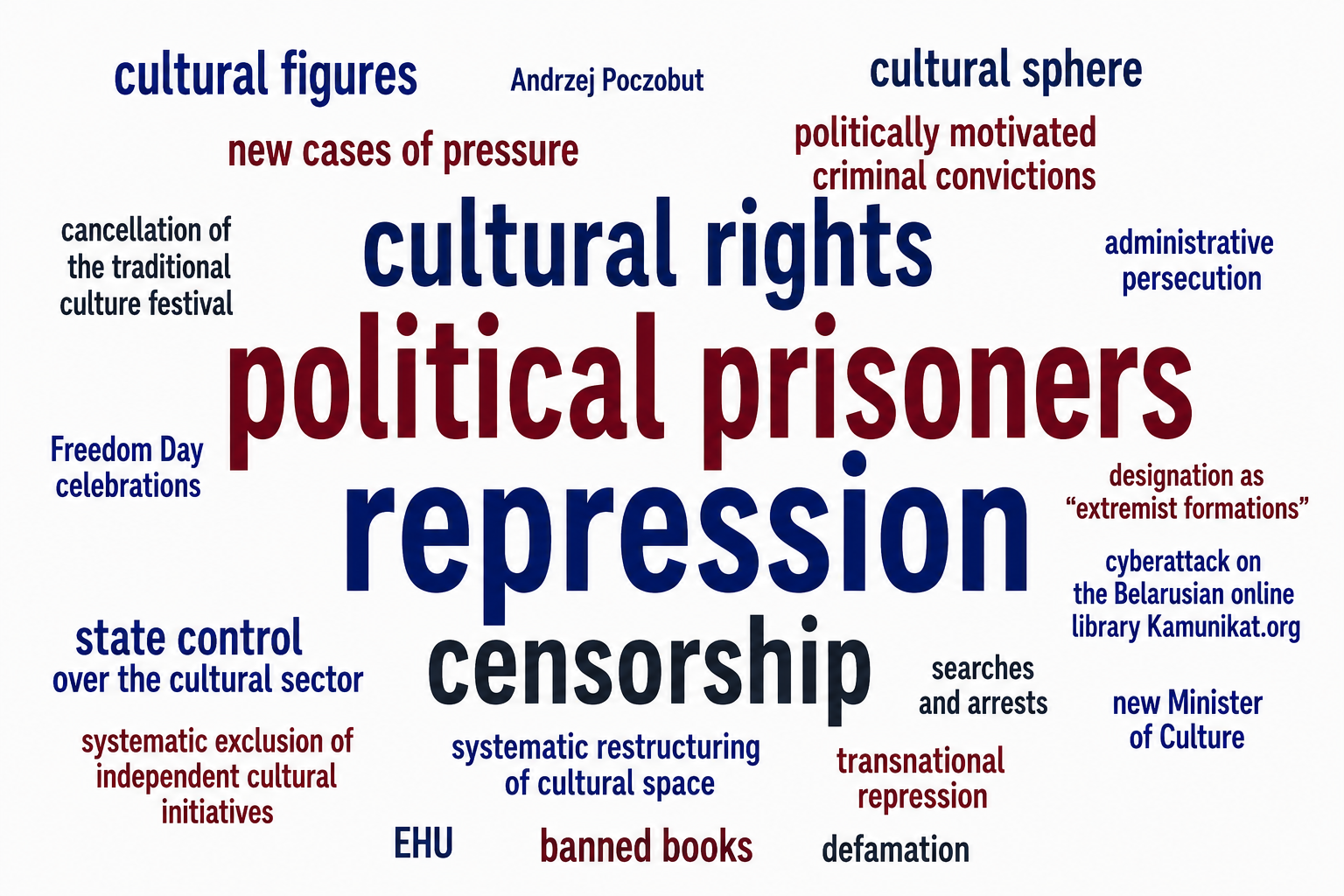
On 29 June 2026, at the 62nd session of the UN Human Rights Council, the UN Special Rapporteur on the situation of human rights in Belarus, Nils Muižnieks, presented his second report. A substantial part of the report is devoted to the situation in the cultural sphere. It notes that repression in Belarus
“has evolved beyond targeting political activists to encompass a systematic restructuring of cultural space, education, language use and historical narratives. Belarusian cultural and national identity and linguistic affiliation are increasingly treated as markers of political opposition”.
Persecution in figures (January – June 2026):
- 738 violations of cultural rights and human rights of cultural figures were documented.
- As of 30 June 2026, Belarus held 859 political prisoners, including at least [1] 61 cultural figures (approximately 7 % of the total number of political prisoners). During the reporting period, human rights defenders recognised at least 16 cultural figures as political prisoners.
- In total, at least 123 representatives of the cultural sector are imprisoned on politically motivated grounds, whether in penal colonies, prisons, pre-trial detention centres, open-type correctional facilities, or under home confinement. Among them are 44 women. 25 writers remain behind bars or subject to restrictions on their liberty.
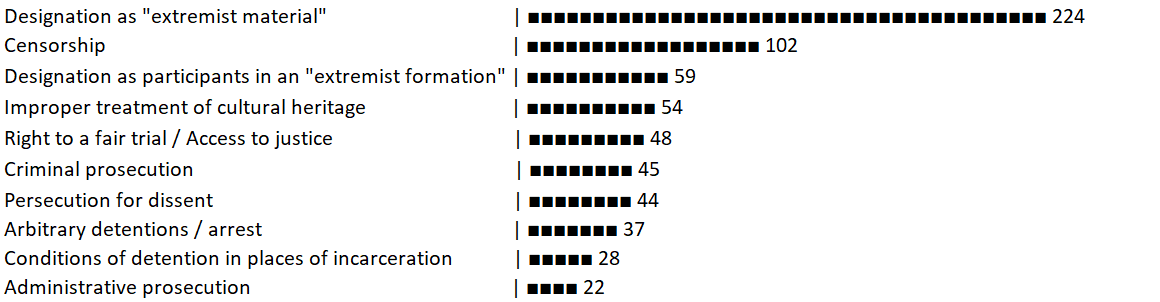
- The most common form of repression during the reporting period was the designation of culture-related materials and the social media accounts of cultural figures as “extremist materials” (224 cases). This was followed by censorship (102 cases, including 33 titles of printed publications banned from distribution in Belarus). In the third place is the designation of cultural figures as members of “extremist formations” (59 cases).
- Top 10 violations:
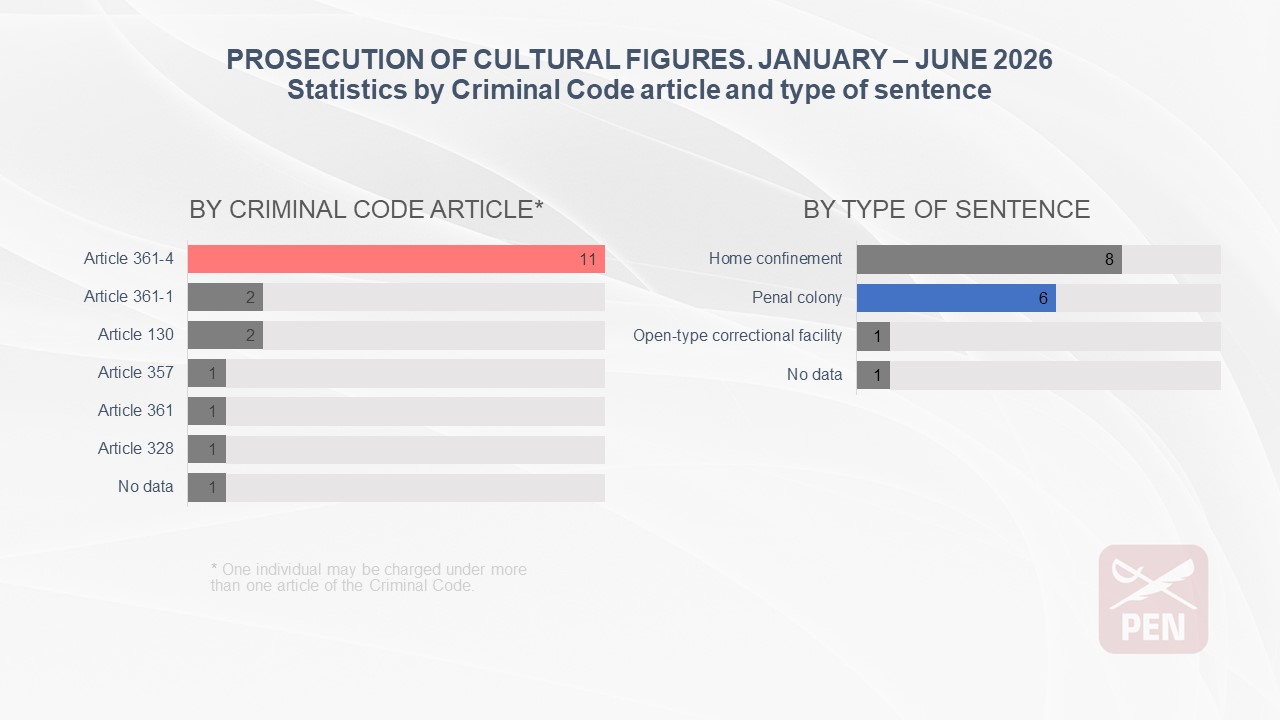
- At least 36 cultural figures were subjected to arbitrary detention or arrest (including one artist who was detained twice). Administrative proceedings were initiated against 14 individuals (22 administrative offence reports in total). At least 16 representatives of the cultural sector faced criminal prosecution; in 11 of these cases the charges included Article 361-4 of the Criminal Code (Facilitating extremist activity), most often in connection with the Biełaruski Hajun case.
- Six representatives of the cultural sector were forcibly expelled or deported from Belarus.
- 19 cultural figures were added to the List of Citizens Involved in Extremist Activity. At least 58 individuals were added to the list of alleged members of “extremist formations” (publisher Andrej Januškievič was included twice).
- Three cultural and educational institutions in Minsk, together with the public association Ethnohistorical Centre “Javar”, which had operated since 1999, were dissolved. In addition, 15 cultural organisations and initiatives were designated “extremist formations”.
- The Ministry of Information added 12 books, including one children’s book, to the List of Extremist Materials. The list of printed publications deemed capable of “harming national security” was expanded by 33 titles. In total, 45 books by Belarusian and foreign authors were banned during the reporting period.
- 54 cases of improper treatment of historical and cultural heritage sites and places of memory were documented.
ARBITRARY DETENTIONS OF CULTURAL FIGURES AND CRIMINAL PROSECUTION
During the first half of 2026, at least 36 cultural figures and workers were subjected to arbitrary detention or arrest (one individual was detained twice).
The mass detentions of publishers and writers in February – March 2026 (documented in the monitoring report for the first quarter), as well as the raid on the Parason creative space in Minsk, continue to have long-term consequences for the cultural sector. Translator and publisher Zmicier Kołas, aged 69, remains imprisoned.
On 23 April, officers of the State Security Committee (KGB) carried out searches, interrogations, and detentions in several Belarusian cities targeting individuals associated with socio-cultural organisations and initiatives. Investigators deliberately sought evidence of “foreign funding”. Some of those detained remain in custody, while the details of the charges against them are still unknown to human rights defenders.
During the reporting period, the following cultural figures were also detained:
- Alaksandr Baranaŭ – businessman from Mazyr and chair of the historical and cultural association Spadčyna Palessia, which the authorities forcibly dissolved in April 2023. He was detained on 5 January and remains in pre-trial detention pending trial in the politically motivated Biełaruski Hajun case;
- Anatol Parachnievič – Catholic priest and local historian from the village of Alkovičy (Vilejka District). He was detained on 16 March. The grounds for his persecution remain unknown, and he is still in custody;
- Andrej Liankievič – photographer. He was detained while crossing the Polish–Belarusian border, allegedly because officers found an “extremist” subscription on his mobile phone. His administrative trial took place on 3 April;
- Alaksiej Chlastoŭ – musician. He was detained on 21 May and, the following day, sentenced to 14 days of administrative arrest under Article 19.1 of the Code of Administrative Offences for alleged petty hooliganism. An account affiliated with the security services claimed that his detention was linked to his failure to respond to traffic police summonses. In a video recorded in anticipation of his possible detention, Chlastoŭ stated that he had recently been summoned three times for various so-called “preventive conversations”;
- as well as other cultural figures.
At least 16 cultural figures faced politically motivated criminal prosecution during the first half of 2026, including:
- Cina Pałynskaja, journalist and non-fiction writer, was sentenced to two years in a penal colony and fined under Article 361-1 of the Criminal Code for cooperating with the Belarusian Analytical Workroom, a Poland-based sociological research organization.
- Aleh Chamienka, musician, researcher, and leader of the folk-modern band Pałac, was sentenced to three years in a penal colony and fined under Article 361-4 of the Criminal Code for cooperating with the Białystok-based Belarusian Radio Racyja where he produced educational programmes.
- Jahor Bužyłaŭ, production director of the jewelry brand Belaruskicry, was sentenced to four years of restricted freedom in an open-type correctional facility under Article 361-1 of the Criminal Code for his work with the brand and for presenting one of its products to Sviatłana Cichanoŭskaja.
- Iryna Jakaŭleva, church artist, was sentenced to eight and a half years in a penal colony and fined under Article 357 of the Criminal Code in connection with the so-called “courtyard chats” case.
- Viktar Jaŭmienienka, Chair of the Vacłaŭ Łastoŭski Society of History Enthusiasts, was sentenced to a term in a penal colony under Article 361 of the Criminal Code. The grounds for his prosecution remain unknown.
- Jahor Ciuškievič, musician and employee of the Brest Puppet Theatre, was convicted in a second criminal trial, initiated while he was already serving a previous sentence. The length of his new sentence and charges applied remain unknown. His first sentence was six years in a penal colony under Articles 341, 361-1 and 361-4 of the Criminal Code.
The overwhelming majority of the cultural figures listed below were prosecuted in connection with the Biełaruski Hajun case for providing information of public interest to the Biełaruski Hajun OSINT monitoring project, established by Anton Matolka in January 2022, shortly before Russia’s full-scale invasion of Ukraine, to track the movement of Russian troops and military equipment across Belarus. Human rights defenders currently have only limited information about these prosecutions:
- Cimafiej Puhačoŭ, drummer – sentenced to three years in a penal colony under Article 361-4 of the Criminal Code.
- Uładzimir Patapienka, founder of a music school – sentenced to home confinement under Articles 361-4 and 328 of the Criminal Code. He was among the 235 people pardoned in March 2026 who were allowed to remain in Belarus.
- Natalla Bačurynskaja, wildlife photographer – sentenced to three years of home confinement and a fine under Article 361-4 of the Criminal Code. Following appeal, her original sentence of three years in a penal colony and a fine was commuted.
- Jana Syrevič, designer – sentenced to home confinement under Article 361-4 of the Criminal Code.
- Michaił Masalevič, historian and tour guide – sentenced to three years of home confinement under Article 361-4 of the Criminal Code.
- Natalla Dziadula, employee of the Belarusian State University of Culture and Arts – sentenced to home confinement under Articles 130 and 361-4 of the Criminal Code.
- Jana Maskalova, designer and illustrator – sentenced to home confinement under Article 361-4 of the Criminal Code.
- Kirył Łojka, member of the ChurchBrass brass ensemble – sentenced to home confinement under Article 361-4 of the Criminal Code.
- Sviatłana Karalova, singer and vocal teacher – sentenced to home confinement under Article 361-4 of the Criminal Code.
- Alaksandr Lubiančuk, journalist and local historian – sentenced to one year in a penal colony under Articles 361-4 and 130 of the Criminal Code. Of the original four-year prison sentence, three years were credited as time already served under a previous conviction.
CONDITIONS OF DETENTION OF CULTURAL FIGURES IN PLACES OF INCARCERATION
Andrej Pačobut (Andrzej Poczobut), journalist, poet, and activist of the Union of Poles in Belarus, was detained on 25 March 2021. On 8 February 2023, he was sentenced to eight years in a medium-security penal colony under Articles 130 and 361 of the Criminal Code. The charges against him included the alleged “glorification of the Home Army (Armia Krajowa)” and an alleged “attempt to detach part of Belarus in favour of Poland”. Among the evidence used against him were declassified NKVD interrogation records from the 1940s. On 28 April 2026, Pačobut was released as part of an exchange deal between Belarus and Poland. By that time, he had spent five years and one month in Penal Colony No. 1 in Navapołack.
Throughout his imprisonment, he was subjected to a regime of total control and systematic physical and psychological pressure intended to exhaust and break him. This repressive treatment included intolerable living conditions – constant hunger, cold, the pervasive smell of chlorine, and prison clothing so worn out that he was afraid to wash it too often for fear it would fall apart. Prison staff carried out demonstrative inspections and searches twice a day and systematically fabricated minor disciplinary violations, using trivial everyday matters or insignificant inaccuracies as formal grounds for punishment.
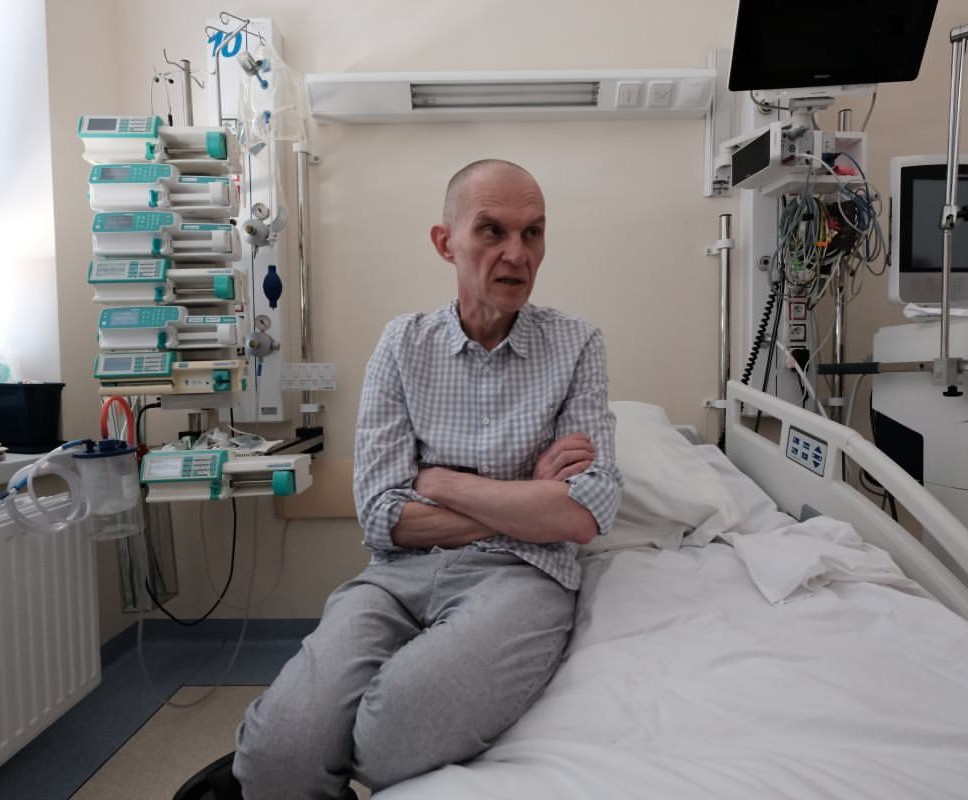
One of the principal methods of pressure used against Pačobut was repeated placement in a punishment cell – a cold concrete cell for periods of up to 30 consecutive days. The authorities also sought to break him psychologically and undermine his dignity by forcing him to perform work considered degrading within the prison hierarchy, effectively turning prisoners into social outcasts. Refusal to carry out such humiliating work, or inability to perform physically demanding labour because of poor health, resulted in prolonged confinement in a cell-type punishment facility. During his first nine months in the colony, he spent six months in a cell-type punitive facility and three months in a punishment cell.
The prison authorities reduced the journalist to a state of severe physical exhaustion. He suffered from cardiac arrhythmia and high blood pressure and underwent surgery behind bars. In addition, Pačobut was deprived of parcels, correspondence with his family, and family visits.
For the final six months of his imprisonment, he was held in complete isolation. “There was no one I could exchange even a single word with, because they realised that I found solitude harder to bear than being surrounded by many people or enduring harsh prison conditions,” Pačobut said in an interview with LRT.lt. He was released emaciated and physically exhausted.
In February 2026, former political prisoner, blogger and journalist Ihar Łosik reported on the deteriorating health of Jaŭhien Burło, a musician with the band Tor Band, who has been imprisoned for his musical work for three and a half years and is serving his sentence in Penal Colony No. 3 in Viciebsk. Burło suffers from osteoporosis in both legs. He has already undergone surgery on his right leg but urgently requires an operation on the left. After months of suffering, he is now able to move only with crutches.
Journalist and writer Siarhiej Sacuk, already imprisoned for more than four and a half years because of his journalistic work, is serving his sentence in Penal Colony No. 15 in Mahiloŭ, is reportedly experiencing serious health problems. According to those close to him, he requires a pacemaker, without which every day is a gamble.
Reports also indicate that Vacłaŭ Areška, the 71-year-old cultural scholar, has almost completely lost his eyesight in prison. Already imprisoned for more than four years, he is serving an eight-year sentence in Penal Colony No. 22 in Ivacevičy.
Catholic priest and local historian Anatol Parachnievič, detained in March 2026 on unclear charges, remains in a serious condition after suffering a heart attack in prison. For many years, he collected and preserved items of Belarusian national cultural heritage and established a small museum at the church in the village of Alkovičy in the Vilejka district.
Former political prisoners reported that artist Ivan Viarbicki has spent more than 1,065 days (almost three years) in a punishment cell or solitary confinement since his arrest on 21 October 2020. In April 2026, he was transferred to Penal Colony No. 9 in Horki and immediately placed in a punishment cell. Viarbicki has already faced criminal prosecution three times under Article 411 of the Criminal Code (Malicious disobedience to the lawful demands of the prison administration), a provision routinely used to artificially prolong prison sentences. Because he has been included on the “terrorist list”, he is barred from receiving financial support from relatives. In practice, he is being held incommunicado: for almost two years, his family has had no contact with him whatsoever.
Ihar Alinievič, author of prison literature and the first recipient of the Francišak Alachnovič Prize, has now spent six years in prison without family visits, telephone calls, money transfers, medication, or food and clothing parcels. As of the summer of 2026, he remains confined in a punishment cell in Penal Colony No. 20.
At the end of May 2026, it became known that businessman and cultural manager Eduard Babaryka had also been transferred to a punishment cell. Earlier, in December 2025, his father, former presidential candidate Viktar Babaryka, had been pardoned and deported from Belarus. Eduard Babaryka, however, continues to be held in prison, effectively as a hostage. He has now spent more than six years behind bars.
Journalist and writer Ihar Iljaš is also being held in extremely harsh conditions, subjected to targeted pressure, and suffering health problems caused by work in hazardous prison production facilities. He has had no direct contact with his wife, former political prisoner Kaciaryna Andrejeva (Bachvałava), who was released following a pardon on 19 March 2026, for several years. Since Ihar’s arrest in October 2024, the couple have been unable to exchange letters or speak by telephone.
TRANSNATIONAL REPRESSION OF CULTURAL FIGURES
Over time, repressive measures targeting Belarusian cultural figures in political exile have not only continued but have intensified, accounting for an increasingly large share of the violations documented through this monitoring. This trend is also driven by the growing scarcity of information about persecution inside Belarus.
CRIMINAL PROSECUTION AND SEARCHES OF RELATIVES
At the end of January 2026, Mikoła Dziadok – blogger and author of prison literature, who had been pardoned in September 2025 and deported to Lithuania – learned that a new criminal case had been opened against him for allegedly publishing or making “extremist” statements. His parents were summoned for questioning, while state propaganda outlets intensified their smear campaign against him, publishing insults and defamatory attacks.
In February, the parents of writer Saša Filipienka (Sasha Filipenko), who now lives in Switzerland, were again subjected to a search. This was how he learned that a new criminal case had been initiated against him under Article 361(2) of the Criminal Code. According to the authorities: “The suspect, Alaksandr Alaksandravič Filipienka, repeatedly used the internet to give an interview entitled ‘Banned Books in Belarus: Why Saša Filipienka’s Novels Cannot Be Read – and How They Can Still Be Read’ on the Obychnoye Utro YouTube channel“.
In March, the Office of the Prosecutor General opened a criminal case against presenter and educator Kaciaryna Vadanosava, who lives in Poland, for her “author’s interpretation of historical events during the Second World War”. Her lectures published on YouTube were deemed to constitute “rehabilitation of Nazism” under Article 130-1(3) of the Criminal Code.
A new criminal case was initiated against opera singer Marharyta Laŭčuk, who lives in Ukraine, allegedly for insulting Alaksandr Łukašenka. The authorities once again searched the home of her elderly parents in Belarus.
In the second half of May, searches were carried out across Belarus at the registered addresses of political exiles. The searches were prompted by participation in Freedom Day events held in Warsaw, Vilnius, Białystok, and other cities with Belarusian diaspora communities. As of 25 May, human rights defenders had documented more than 30 searches. The criminal proceedings were initiated under provisions of the Criminal Code relating to “crimes against the state” and “extremist crimes”. Among the publicly known cases was the opening of a criminal case against writer, political figure and former political prisoner Pavieł Sieviaryniec, who was deported to Lithuania following his release. At the same time, human rights defenders are aware of criminal prosecutions against individuals who had not in fact participated in the Freedom Day rallies.
SPECIAL JUDICIAL PROCEEDINGS AND TRIALS IN ABSENTIA
On 18 May 2026, special judicial proceedings were initiated against musician Siarhiej Michałok, founder and frontman of the bands Lyapis Trubetskoy and Brutto, who has lived outside Belarus for many years. He was charged under Article 130(1) (Incitement to hatred or enmity) and Article 368(1) (Public insult of the President) of the Criminal Code
Earlier, in January 2024, both the music video and lyrics of the song “Nie być skotam” (“Not to Be Cattle”) by Lyapis Trubetskoy, based on a poem by the Belarusian literary classic Janka Kupała, had been designated “extremist materials”. In January 2025, Michałok’s photograph also appeared on a police wanted notice board, although at that time he was charged only under Article 368 of the Criminal Code.
On 8 June, special judicial proceedings were also initiated against Kaciaryna Mankievič, vocalist of the band Dymna Lotva. She was charged under five provisions of the Criminal Code: Article 289-1(1), Article 290-1(1), Article 361-4(1) and (2), Article 366-1, and Article 368(1).
In November 2025, seven songs by the Belarusian post-metal/doom metal band, published on YouTube, had been designated “extremist materials”. According to the band’s own description, its lyrics primarily explore themes of nature, death, and human emotion.
Both musicians were ordered to appear before the criminal prosecution authorities in Minsk.
In June, it also became known that a trial in absentia would soon begin against cultural manager Pavieł Mickievič, Chair of the Board and Head of Projects at the Okno na Wschód Foundation, who has lived in Poland for more than twenty years. He is charged under Article 361-4(1) and (2) (Facilitating extremist activity) and Article 369-1 (Discrediting Belarus) of the Criminal Code.
WANTED LISTS
Dozens of cultural figures persecuted in Belarus ultimately find themselves on the Ministry of Internal Affairs’ wanted lists. Owing to union agreements between Belarus and Russia, this means that they are entered not only into the Belarusian database but also into the wanted database of the Russian Federation. Individuals are typically added to the Russian database after first being declared wanted in Belarus, meaning that they become subject to search by the authorities of both countries simultaneously.
Those currently listed include:
- Writers and intellectuals: Valeryja Kustava, Alaksiej Dzikavicki, Piotr Rudkoŭski, Pavieł Barkoŭski;
- Researchers and historians: Valeryja Čarnamorcava, Viktar Jakubaŭ;
- Musicians: Lavon Volski, Andrej and Viera Mamojka, Kaciaryna Mankievič;
- Film and theatre directors: Andrej Kašpierski, Andrej Kurejčyk;
- Cultural managers: Jury Mielaškievič, Stanisłava Ciarencjieva, Rehina Łavor, Siarhiej Huń, Pavieł Mickievič;
- Owners of shops selling goods with Belarusian national symbols: Siarhiej and Volha Vieramiejenka, Ihar Kazmierčak;
- Other cultural figures.
For each of these individuals, inclusion in the wanted database creates a risk of detention and extradition.
DESIGNATION OF SOCIAL MEDIA ACCOUNTS AS “EXTREMIST MATERIALS”
During the first quarter of 2026, dozens of social media accounts belonging to Belarusian cultural figures living in political exile (in some cases, Polish citizens) were designated “extremist materials”.
- Facebook pages belonging to linguist and prominent Belarusian public figure Vincuk Viačorka; producer and film director Volha Čajkoŭskaja; and writer Jaŭhienija Paraščanka (Juhasia Kalada);
- Instagram accounts belonging to photographer Pavieł Chadynski; cultural manager Alaksandr Łapko; educator and author Maryna Mientusava; writer Hanna Złatkoŭskaja; artist and designer Uładzimir Malaŭka; Paweł Stankiewicz, Director of the TUTAKA Foundation; musicians Klim Małażavy and Kaciaryna Vadanosava; writer and journalist Alaksiej Dzikavicki; Janusz Hawryluk, founder of the Bulbamuvi Film Festival; and actor Michaił Zuj;
- Threads accounts belonging to journalist and local historian Rusłan Kulevič; poet and blogger Valery Rusielik; musician and journalist Kaciaryna Pytleva; and director Andrej Kurejčyk.
The authorities also designated as “extremist materials” the social media accounts of former political prisoners from the cultural sphere who, following their release, now live in exile. These included Threads accounts belonging to philanthropist, businessman and former presidential candidate Viktar Babaryka; musician and civic activist Maryja Kalesnikava; prison literature author Mikoła Dziadok; and musician Uładzisłaŭ Navažyłaŭ. Also designated were the Instagram accounts of journalist and local historian Jaŭhien Mierkis; activist and concert organiser Illa Mironaŭ; and cultural manager Uładzimir Bułavinski; the Facebook account of writer and political figure Pavieł Sieviaryniec; and the YouTube channel, other social media accounts, and two email addresses belonging to blogger and documentary filmmaker Pavieł Spiryn.
DEFAMATION
Public defamation and attacks on the honour and dignity of cultural figures by pro-government propagandists and state-controlled media in Belarus continue unabated.
For several years, journalist Andrej Mukavozčyk has repeatedly published abusive articles targeting well-known public figures in the online edition of one of the country’s principal state-owned newspapers, SB. Belarus Segodnya, without facing any consequences. One example is his article of 26 May 2026, directed against cultural scholar and writer Julija Čarniaŭskaja. The attack was prompted by a feature published on the website of the Jakub Kołas Central Scientific Library to mark the 115th anniversary of the birth of the Belarusian poet Vasil Vitka. The article noted that the poet’s intellectual and spiritual legacy “continues to live not only in his books but also in his family – his granddaughter, the distinguished literary scholar and cultural researcher Julija Čarniaŭskaja, preserves and develops her grandfather’s traditions, highlighting the unbroken continuity of Belarusian culture across generations“. In response, Mukavozčyk referred to the library’s staff as “library rats”. He also subjected Čarniaŭskaja – who holds a Candidate of Sciences degree, has authored more than 200 academic articles and numerous scholarly books, spent six months under house arrest in the TUT.BY case [2], and now lives in exile in Poland – to a series of degrading insults, calling her, among other things, “mother-toad”, “our blogger”, and “madam for the simpletons”, alongside other offensive epithets. This is only one example of the articles that the same author has been publishing with consistent regularity over the past six years.
CRIMINALISATION OF CULTURAL ACTIVITY: EXPANSION OF THE LIST OF “EXTREMIST” ORGANISATIONS
DESIGNATION OF CULTURAL ORGANISATIONS AS “EXTREMIST”
During the first half of 2026, 15 Belarusian cultural and educational organisations legally operating abroad were designated “extremist” by the Belarusian authorities. They included publishing houses, cultural and educational initiatives, a film festival, jewellery and clothing brands, a satirical media project, and other organisations dedicated to promoting Belarusian culture, language, history and national identity.
During the first quarter of 2026, the following organisations were designated “extremist formations”: the cultural and educational campaign Budźma Biełarusami! (Let’s Be Belarusians!), the literary and human rights organisation PEN Belarus, the independent Belarusian publishing houses Gutenberg Publisher, Łohvinaŭ, and Januškievič, the Belarusian online library and publishing house of the Kamunikat Foundation, the cultural and educational initiative Spadčyna Biełarusi (Heritage of Belarus) in Wrocław, the Paŭnočnaje Zziannie (Northern Lights) Film Festival, and the organisation Brama Spadčyny (Heritage Gate), whose mission is to preserve the shared cultural and historical heritage of Belarus and Poland. A more detailed account of each of these organisations was provided in the previous monitoring report.

During the second quarter of 2026, the following organisations were designated “extremist formations” by decisions of the State Security Committee (KGB) or the Ministry of Internal Affairs:
× Belarusian Council for Culture – a community of experts, cultural managers and artists established in Estonia [3] in October 2020, together with its Polish legal entity, Fundacja Białoruska Rada Kultury, as well as the Mahistrat, Vaśminoh, and ArtPower Belarus projects – by decision of the KGB on 9 April. This is the second time the organisation has been added to the list; the Ministry of Internal Affairs designated it “extremist formation” on 7 June 2022.
× Znivien – a Belarusian clothing and merchandise brand founded in Poland in 2021 by Uładzimir Malaŭka and Pavieł Dziarkač [4] (KGB’s decision on 5 May).
× The Krama Store – a Belarusian showroom and online shop established in Poland specialising in clothing, accessories and souvenirs featuring Belarusian national motifs [5] (KGB’s decision on 5 May).
× LVS. Language School – an online language school established in Poland that, among other things, provides tutoring for school examinations [6] (KGB’s decision on 5 May).
× ChinChinChannel – a popular Belarusian satirical project created by Michaił Zuj and Dzmitry Jesianievič, former actors of the Janka Kupała National Theatre, together with director Andrej Kašpierski [7] (Ministry of Internal Affairs’s decision on 16 June).
By decision of the Supreme Court of the Republic of Belarus on 14 April, the European Humanities University (EHU) [8] – an international university based in Vilnius, Lithuania, providing education in the arts, humanities and social sciences – was designated an “extremist organisation”.

The websites, social media pages and online communities of all the above organisations and initiatives have likewise been added to the National List of “extremist materials”.
For people living in Belarus, the designation of organisations as “extremist” significantly increases the risks associated with any interaction with these initiatives, as well as with their information and cultural products. Depending on the circumstances, such interaction may give rise not only to administrative liability but also to criminal prosecution.
This designation also has long-term consequences for the cultural institutions themselves. Summarising the first four months after the Januškievič Publishing House had been designated an “extremist formation”, its director Andrej Januškievič noted a significant decline in readership from Belarus. He wrote, “People are afraid. Book sales are falling. Today this has become a very noticeable trend.” Consequently, the publishing house has accumulated substantial unsold stock, further worsening its financial position. In Januškievič’s assessment, designating publishing houses as “extremist” constitutes a form of pressure on cultural institutions that possess significant material assets. Around 30,000 copies of books remain in the warehouses of the Januškievič Publishing House alone. For organisations whose work depends directly on active audience engagement, decisions of this kind pose long-term threats to their sustainability.
PRESSURE ON THE EUROPEAN HUMANITIES UNIVERSITY: A CHRONICLE OF PERSECUTION
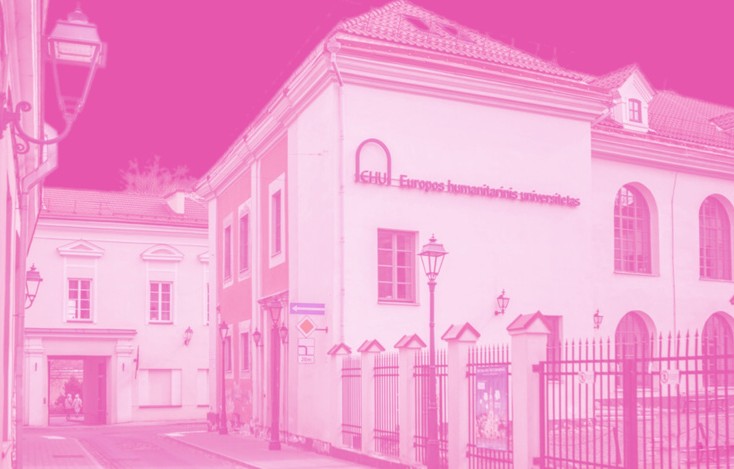
The European Humanities University (EHU) is an international private university founded in Minsk in 1992. In 2004, the Belarusian authorities revoked its licence, forcing the university to cease operations in Belarus and continue its work in exile in Vilnius, Lithuania. As of September 2025, EHU had approximately 1,500 students, around 74 % of whom were Belarusian citizens.
Escalation of pressure
In recent years, EHU has been subjected to systematic pressure from the Belarusian authorities.
- 2024: The beginning of an active campaign. In January 2024, the first serious threat emerged when Belarusian state television accused EHU of “training people for protests” and “collaborating with the Office of Sviatłana Cichanoŭskaja”.
- August 2024 – February 2025: The university faced a series of provocations and acts of vandalism. Nationalist graffiti targeting Belarusian students repeatedly appeared on the walls of its buildings in Vilnius. EHU’s leadership regarded these incidents as part of an organised political campaign.
- 20 August 2025: EHU’s website and social media accounts were designated “extremist materials” in Belarus.
- 15 September 2025: It became known that, at the request of the KGB, Prosecutor General Andrej Švied had applied to the Supreme Court to have EHU designated an “extremist organisation”, its activities prohibited in Belarus, and its symbols and insignia banned.
- 14 April 2026: The Supreme Court of the Republic of Belarus officially designated EHU an “extremist organisation”. The authorities accused the university of “destabilising the socio-political situation” and “promoting alternative interpretations of historical events,” alleging that it was being used by the intelligence services of neighbouring states to undermine Belarus’s national interests.
The university was also subjected to other forms of provocation, including attempts by individuals to gain access to the campus under the pretext of filming a documentary, as well as coordinated harassment of students on social media.
Consequences for the EHU community
The designation of EHU as an “extremist organisation” created critical risks for everyone associated with the university – students, alumni, staff and partners. Any involvement in university activities, participation in joint projects, reposting EHU content, possessing an EHU diploma, or even mentioning the university on a CV may be interpreted as facilitating extremist activity. Any financial transaction involving the university, including the payment of tuition fees, may likewise be classified as financing extremist activity.
The Belarusian Helsinki Committee has noted that this is the first case in which the designation of an organisation as “extremist” has had consequences on such a scale for people with no political profile.
- Mass searches and interrogations. Beginning in early June 2026, a wave of searches was carried out across Belarus targeting individuals connected with the university. By 15 June, more than 60 searches had been documented The authorities searched for documents confirming links to EHU, including receipts for tuition payments.
- Pressure on part-time students. Cases have been documented in which students were forced to submit applications for withdrawal from the university and were dismissed from their jobs.
- Criminal prosecution. Human rights defenders are aware of criminal cases initiated for “facilitating extremist activity” and “financing extremist activity”, including on the grounds of paying tuition fees dating back to
- Pressure on families. The authorities have threatened the parents of EHU students with criminal prosecution to force students to return from Lithuania to Belarus.
- Loss of students and academic staff. During the first month after EHU was designated an “extremist organisation”, around 100 students left the university, while two lecturers terminated their cooperation with the institution. Earlier, in September 2025, several students and two members of academic staff had already been forced to leave the university.
- A forced choice. Those who are not already living in exile face a stark dilemma: return to Belarus and live under the constant threat of persecution, or remain abroad in forced exile, often encountering serious difficulties in regularising their legal status, as students lose the basis for their lawful residence outside Belarus.
International response
The case has become unprecedented in international practice.
On 15 April, the Republic of Lithuania strongly protested the decision of the Belarusian authorities to designate the European Humanities University, which has been lawfully operating in Lithuania since 2004, an “extremist organisation”. The Lithuanian Ministry of Foreign Affairs described the decision as politically motivated, unjustified, and contrary to the principles of international law and Lithuania’s sovereignty. Vilnius stated that it did not recognise the legal validity of the Belarusian decision on Lithuanian territory and called for its immediate revocation.
Statements of support for EHU were also issued by the Ministries of Foreign Affairs of Sweden, Ukraine, Latvia, and Estonia.
CENSORSHIP, BANNED BOOKS, AND CULTURE-RELATED MATERIALS DESIGNATED “EXTREMIST”
For several years now, censorship has remained one of the most widespread and persistent violations of cultural rights and human rights of cultural figures in Belarus. The monitoring report for the first quarter provides a more detailed account of cases from that period. Overall, 102 cases of censorship were documented during the first half of 2026 (cases involving the designation of materials as “extremist” are recorded separately). These included:
- cancellation of approved cultural and commemorative events, including Valentine’s Day celebrations at a state institution in Homiel, a memorial ceremony at the Yama Memorial Complex in Minsk, and the traditional Belarusian Hukannie Viasny (Calling the Spring) celebration in the town of Vietka;
- persecution for celebrating traditional customs, including administrative charges brought against participants in a farewell-to-winter celebration held on the premises of the Spadčyna restaurant in Homiel;
- cancellation of annual festivals, including Soncastajannie, Vostraŭ, Festiwow, and the Festival of the Sun;
- the addition of new performers to the unofficial “blacklist” (STOP list) of artists whose music is prohibited at concerts or in karaoke clubs, including the cover band Discowox, Maruv, Alyona Alyona, Andrei Makarevich, Maksim Pokrovsky, and others;
- refusal to issue touring permits for concerts;
- censorship of artworks, including the removal of Kałychanka (Lullaby), a painting by former political prisoner Hienadź Drazdoŭ, from an exhibition that had already opened;
- removal from the internet of content (academic articles, reference materials and social media accounts) created by “disloyal” authors or mentioning them;
- expansion of the list of publications prohibited from distribution on the grounds that they allegedly “threaten the national security” of Belarus, with 33 new books added;
- removal of books from libraries, including the titles that are not on any official lists of “extremist” or otherwise prohibited materials;
- confiscation of manuscripts from political prisoners: before journalist Kaciaryna Andrejeva was released on 19 March 2026, prison authorities confiscated her entire archive – diaries, poems, notes, letters, and everything she had written over five years of incarceration;
- blocking of websites: Knihi.by and LiveLib;
- persecution for historical education, including criminal proceedings against presenter Kaciaryna Vadanosava over her lectures on YouTube, as well as numerous other documented cases of direct and indirect censorship and violations of cultural rights, including incidents that never became public.
HUKANNIE VIASNY (CALLING THE SPRING): PROSECUTION FOR A FOLK RITUAL
On 21 March, several dozen people, including families with children, gathered in the courtyard of the Spadčyna restaurant in Homiel to celebrate Hukannie Viasny (Calling the Spring), a traditional Belarusian folk ritual marking the arrival of spring with songs and circle dances.
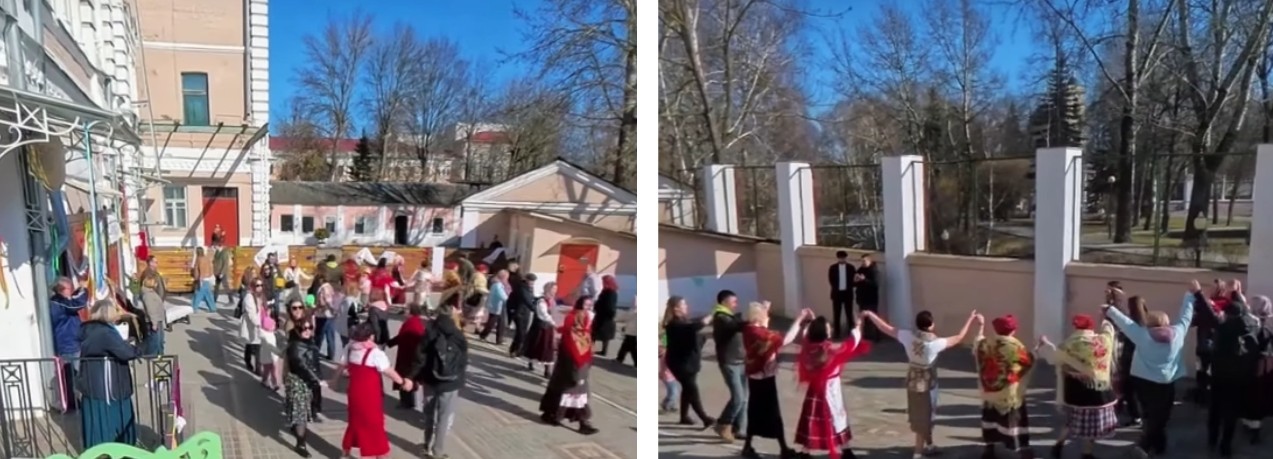
Following the event, participants were subjected to administrative prosecution under Article 24.23 of the Code of Administrative Offences (Holding an unauthorised mass event). As the limitation period for proceedings under this article is two months from the date of the alleged offence, reports of prosecutions continued to emerge throughout May.
At least nine participants were punished with either administrative detention or fines. At least one participant received 15 days of administrative arrest, while five others were fined the maximum amount of BYN 4,500 (approximately USD 1,500). The individual deemed to have organised the gathering was fined BYN 6,750 (approximately USD 2,300). At least one participant was held for eight hours at a district police station for what the authorities described as “preventive work“.
Following the visit by law enforcement officers, the Spadčyna restaurant temporarily closed, citing “technical reasons”. Although it reopened several weeks later, all references to Belarusian culture and cuisine had disappeared from its promotional materials and social media pages.
BOOK BANS AND PERSECUTION OF PUBLISHERS
Persecution of publishers
The first quarter of 2026 saw another wave of unprecedented pressure on independent publishers and booksellers. They faced detentions, interrogations, administrative arrests and criminal prosecution; the activities of the Minsk-based publishing house Technałohija were suspended; the website Knihi.by ceased operations; and the Poland-based Kamunikat Foundation together with the Belarusian exile publishing houses Gutenberg Publisher, Łohvinaŭ, and Januškievič were designated “extremist formations”. Pressure continued throughout the second quarter.
On the night of 6–7 May, Kamunikat.org, an online library specialising in Belarusian-language books, was targeted by a cyberattack that was most likely coordinated by the Belarusian authorities. The attack rendered the website inoperable. On 7 May, the Foundation’s director, Jarosław Iwaniuk, wrote on social media that the attack had “destroyed more than 25 years of work”. Four days later, he reported the incident to the Białystok branch of Poland’s Central Bureau for Combating Cybercrime.
Restoring the website took more than a month. On 19 June, during a public event, Iwaniuk announced that Kamunikat had been restored almost entirely to its previous state, with only a small number of files – primarily illustrations accompanying archived news articles – lost permanently. Following the attack, the organisation strengthened its digital security measures wherever possible.
This was not the first cyberattack against Kamunikat.org. A previous attack took place in 2023, after the site’s main domain was blocked in Belarus. Pressure continued thereafter. On 26 September 2025, the website and several of the organisation’s social media accounts were designated “extremist materials”. In December 2025, there was another attempted hack. Then, on 3 March 2026, the KGB included the Kamunikat Foundation – together with the Łohvinaŭ and Januškievič publishing houses – in a fictitious “coalition of publishing houses”, designating it an “extremist formation”. On 7 May, the website came under cyberattack once again, and on 29 June 2026, two additional Kamunikat social media accounts were added to the list of “extremist materials”.
During the first half of 2026, the social media accounts of the following publishing houses were designated “extremist materials”:
- Gutenberg Publisher – Instagram account (12 February);
- RozUM Media – Threads account (19 May);
- Vesna Publishing House – Facebook page (21 May);
- Połackija Łabirynty – Instagram account (19 June);
- Kamunikat – accounts on Odnoklassniki and VKontakte (29 June).
Banned books
During the reporting period, a total of 45 books were designated either “extremist” or “harmful”.
- 12 books by Belarusian authors were added to the List of Extremist Materials. These included The Next Stop Is Death, a detective novel by Kamiła Cień; The Last Generation, the debut novel by Makar Vałynkin about the lives of young people in Minsk after 2020; Where We Are Not, the dystopian debut novel by Maks Ščur; Historical Works. Volume I by Belarusian national figure Alaksandr Cvikievič; as well as several analytical reports on socio-political issues.
The ban on Cvikievič’s work echoes Soviet-era practices. In June 1937, the authorities of the Byelorussian SSR ordered that all his books be burned. In December of the same year, Alaksandr Cvikievič was executed in Minsk.
- 33 books were added to the official list of publications deemed capable of “harming the national interests of the Republic of Belarus”. These included The Wild Boys (1971) by William S. Burroughs – a landmark work of postmodern and countercultural fiction that has profoundly influenced contemporary literature, music (including the eponymous hit by Duran Duran), and popular culture; The Chestnut Man by Søren Sveistrup, the bestselling Nordic noir novel later adapted by Netflix; and the popular M/M romance trilogy Him, Us, and Epic by Sarina Bowen and Elle Kennedy, one of the world’s most commercially successful examples of contemporary sports romance fiction.
As of the end of the reporting period, the list of books whose distribution the Belarusian authorities consider a threat to the country’s national interests contained 257 titles (formally 258, although one title is listed twice). The list is maintained by a special Commission established under the Ministry of Information in October 2021. The Commission comprises 22 members, including government officials, representatives of the security services, and employees of state research institutions. Further information about its composition is available in an article published by Naša Niva.
A complete list of books included in both official registers is maintained on a dedicated PEN Belarus website (except for religious publications listed as “extremist materials”, and certain other works whose classification may be open to differing interpretations).
Confiscations from bookshops, libraries and penal colonies
Following the February raids targeting writers and the designation of several publishing houses as “extremist formations”, bookshops across Belarus began removing all books published by the affected publishers from their shelves.
Libraries have likewise been instructed to remove all publications included in the List of Extremist Materials, while KGB officers regularly carry out inspections of library collections. There have also been repeated demands to remove books that do not appear on any official list of prohibited or “unreliable” publications. As a result, libraries have confiscated all books by Alhierd Bacharevič, Radio Prudok by Andrej Horvat, Where Our Kin Comes From by Uładzimir Arłoŭ, and numerous works by other Belarusian authors.
Books that remain entirely legal – including foreign fiction, educational literature and works by authors regarded as “undesirable” – have also been removed from libraries within the penitentiary system, particularly in penal colonies.
In addition, there exists a non-public blacklist of books that second-hand bookshops are “not recommended” to accept, including works by Russian authors Dmitry Bykov and Mikhail Veller.
Culture-related materials designated as “extremist”
Some of the materials added to the List of Extremist Materials during the first half of the year have already been discussed elsewhere in this report, including books, the social media accounts of exiled cultural figures, and publishing houses.
The following cultural works and online resources should also be noted:
- the song I Shot a Policeman by the band Krambambula, several works by the bands M8L8TH and Nežegol, as well as the social media accounts of the band Naviband and the singing community Volny Chor (Free Choir);
- the Facebook pages of the Francišak Skaryna Belarusian Language Society (Lida branch), the Free Belarus Museum, and the Belarusian Institute of Arts and Sciences (BINiM), together with the Instagram accounts of the Ivan Łuckievič Belarusian Museum in Vilnius and the Free Belarusian University;
- the website, YouTube channel and social media accounts of the Brest theatre Kryły Chałopa, together with the accounts and mobile application of the documentary audio plays Brest Stories Guide;
- YouTube uploads of the documentaries The Road to Kurapaty (produced by Belarusfilm), Blood and Ashes of Dražna, The Almost Forgotten Forest, Belarus under German Occupation, and other historical documentary films; the Facebook pages of Belsat Doc; and the Instagram account of the independent Belarusian film festival Bulbamovie;
- a series of Telegram sticker packs, including those created by the audiobook publisher Knižny Voz and actor Alaksandr Ždanovič (Malavanyč);
- the Facebook page of artist Aleś Puškin, who died in prison in July 2023;
- and even the Instagram account of the Belarusian Designers’ Union, an organisation that had previously been effectively absorbed into the state’s official system of creative unions.
STATE POLICY IN THE FIELD OF CULTURE: PLACES OF MEMORY, LANGUAGE REPRESENTATION, USE OF FORCE, AND LEGISLATIVE CHANGES
Cooperation with the Russian Federation within the framework of the Union State remains one of the Belarusian state’s cultural policy priorities. The authorities have also continued to develop an official policy of memory centred on the concept of the “genocide of the Belarusian people during the Great Patriotic War”. Within this framework, Holocaust victims are being reburied, criminal proceedings relating to wartime events continue, and the state memorial calendar is being expanded. For the first time, in 2026, the authorities officially commemorated not only 9 May (Victory Day) but also 22 June, the anniversary of the outbreak of the German-Soviet war.
Several additional developments also characterise the current direction of state cultural policy.
Neglect of memorial sites and linguistic discrimination against Belarusian literary classics
The Memorial Site – Birthplace of Zmitrok Biadula, a protected heritage site included in the State List of Historical and Cultural Heritage of the Republic of Belarus, remains in a state of neglect. The site is associated with the life of the Belarusian writer Zmitrok Biadula, whose 140th birth anniversary is being marked in 2026. While a new monument at the writer’s grave was ceremonially unveiled at the end of 2025, the house in which he was born continues to fall into disrepair.
The Rahačoŭ home of another Belarusian literary classic, Uładzimir Karatkievič, has not been granted protected heritage status and remains in private ownership. For many years, the local authorities have failed to resolve the issue of purchasing or expropriating the property from the writer’s heirs. As a result, they have little legal basis for requiring that the building – where Karatkievič frequently stayed and where many of his best-known works were conceived or written – be properly maintained. Nevertheless, preserving the house as an important site of cultural memory should remain one of the priorities of state cultural policy.
Another controversy connected with Uładzimir Karatkievič concerns the disappearance of a mural created in 2020 to mark the 90th anniversary of the writer’s birth on a residential building at 2 Marata Street in Orša. During renovation works, the portrait of the writer, together with reproductions of his manuscripts and drawings, was covered by thermal insulation. As a result, the city lost both a distinctive element of its urban landscape and an important memorial dedicated to one of its most celebrated natives.
To mark the 115th anniversary of the birth of Vasil Vitka, the Jakub Kołas Central Scientific Library published an article about the writer on its website. This publication has already been mentioned in the section concerning the defamation of cultural scholar Julija Čarniaŭskaja, Vitka’s granddaughter. A separate concern is the failure to use the author’s original language. The article was published in Russian and illustrated with Russian-language editions of his works, even though Vasil Vitka wrote both his poetry and prose in Belarusian. Moreover, the article used the Russified version of his pen name – Vasiliy Vitka – which is inaccurate.
To mark the 20th anniversary of the new building of the National Library of Belarus, a special collection of souvenirs was released, including tote bags featuring the names of Belarusian literary classics. However, the names of Francišak Skaryna, Maksim Bahdanovič, and Jakub Kołas were printed in Russian, even though their literary legacy is inseparable from the Belarusian language and culture. In the case of Jakub Kołas, the Russified version of his pen name – Yakub Kolos was also used.
These examples point to the absence of a coherent state policy for safeguarding Belarus’s national cultural heritage. Under a different approach, historically significant sites would receive appropriate legal protection, while in more complex cases – such as the Karatkievič family home – the authorities would seek practical solutions to ensure their preservation.
Inspections and the use of force at cultural events
The situation that has emerged in Belarus in recent years – and has effectively been normalised by the authorities – is characterised using disproportionate coercive measures during cultural events. Militarised methods are employed even against relatively small groups of people gathered for cultural recreation or shared interests.
Such practices are inconsistent with the principles of necessity and proportionality. Rather than engaging with participants through dialogue, the authorities rely on intimidation, demonstrations of force, and actions that undermine human dignity.
These practices include forcing people to lie face down on the ground or floor, violent arrests, prolonged detention without explanation, blanket inspections of identity documents, mobile phones and personal belongings, and the deployment of heavily armed officers in full tactical gear despite the absence of any obvious threat to public safety.
This was precisely how the authorities responded to a private music rave held during the night of 21–22 June in the Naliboki Nature Reserve in the Stoŭbcy District. Following the arrests, the organisers were forced to record so-called “repentance videos” – a form of public humiliation widely used by Belarusian security services against detainees and repeatedly condemned by human rights organisations as a method of coercion and psychological pressure.
In present-day Belarus, such coercive tactics accompany even routine inspections of cultural events. One of the DJs present during the police operation described his experience as follows:
“An hour before my set, they simply forced me face down onto the floor. People carrying assault rifles rushed in… We were kept out in the cold for several hours without any explanation… They pointed the barrel of a rifle directly at my face… They searched everything, especially our mobile phones… They said they were checking what we were doing there”.
The authorities’ approach to security at state-organised cultural events is equally revealing. On 23–24 June, in preparation for the Słavianski Bazar festival in Viciebsk, the Ministry of Internal Affairs conducted public order drills involving military vehicles, explosions, and simulated gunfire. The very fact that military-style exercises of this scale were organised in connection with a cultural festival illustrates the growing militarisation of approaches to the organisation and policing of cultural events.
Legislative changes
- From the beginning of 2026, performers have lost the possibility of organising concerts or performing as sole traders (individual entrepreneurs). Musical performance and concert organisation are no longer included among the activities legally permitted under the individual entrepreneur regime. Such activities may now be carried out only through the establishment of a private unitary enterprise or a limited liability company.
- The Law of the Republic of Belarus No. 138-Z of 15 April 2026 “On Amendments to the Codes Concerning Administrative Liability”, which entered into force on 19 June, introduced several new provisions to the Code of Administrative Offences.
- Article 19.16 establishes administrative liability for the so-called “propaganda” of same-sex relationships, gender transition, and voluntary childlessness, as well as for the dissemination of information presenting paedophilia as acceptable. A comparable provision already exists in Russian legislation.
- Article 24.62 introduces liability for the “unlawful representation of the Republic of Belarus at international events”, including cultural, educational, and sporting events. This provision reflects the continuing expansion of state control over cross-border activities and the international engagement of civil society organisations.
CONCLUSIONS
Although more than twenty cultural figures were pardoned during the reporting period, almost the same number of representatives of the cultural sector were newly recognised as political prisoners. This demonstrates that the overall nature of state policy has not changed and that repression against cultural figures continues.
Between January and June 2026, 738 violations of cultural rights and human rights of cultural figures were documented in Belarus. These included arrests, searches, politically motivated criminal prosecutions, torture and other ill-treatment in places of detention, defamation, forced exile, transnational repression, the designation of cultural organisations as “extremist”, persecution for participation in cultural events, numerous forms of censorship, and other violations.
As of 30 June 2026, at least 61 political prisoners were cultural figures. Overall, at least 123 representatives of the cultural sector, including 25 writers, were deprived of their liberty on politically motivated grounds, whether in prisons, open-type correctional facilities, or under restricted freedom in home confinement.
Since 2020, human rights defenders have documented persecution of more than 2,300 cultural figures, and this number continues to grow. The repression affects not only individual artists and cultural professionals but also the ability to preserve, develop and pass Belarusian culture on to future generations. As noted by the UN Special Rapporteur on the situation of human rights in Belarus, Nils Muižnieks, cultural rights are important because it is what makes Belarus Belarusian; it is what makes Belarus distinctive. As he observed, “Cultural repression has a long-term impact as language, memory and cultural production, which is repressed today, cannot easily be transmitted to future generations”.
The authorities of the Republic of Belarus should immediately and unconditionally release all cultural figures, writers and other individuals deprived of their liberty solely for the peaceful exercise of their rights; end their politically motivated criminal prosecution, torture and other forms of ill-treatment, including prolonged incommunicado detention; ensure prompt, effective and impartial investigations into all allegations of human rights violations; cease persecuting individuals for exercising their rights to freedom of expression and artistic freedom; repeal legislative restrictions that unjustifiably impede cultural activities; and bring an end to the transnational repression of Belarusian cultural figures [9].
[1] The information regarding the number of cultural figures affected is not exhaustive, as details about some individuals do not become known immediately.
[2] The TUT.BY case: the largest politically motivated criminal case ever brought against an independent media outlet in the history of Belarus, initiated in May 2021.
[3] https://byculture.org/pra-nas/.
[4] https://znivien.pl/.
[5] https://www.instagram.com/thekrama.store/.
[6] https://lvs-info.com/.
[7] https://www.youtube.com/channel/UCgymY5xQUPeY48OPWyq8DOA.
[8] https://ru.ehuniversity.lt/.
[9] /en/2025/08/06/upr-2025-joint-pen.html.