
This report draws on data collected by the PEN Belarus monitoring group from open sources, individual contacts, and personal meetings with cultural figures. The information reflects the situation at the time of writing and may be updated as new data becomes available.
Despite efforts to ensure accuracy and completeness, some gaps may remain. These include difficulties in identifying or classifying individuals as cultural figures, due to limited public data. PEN Belarus welcomes clarifications or additional information. If you wish to report a violation, even confidentially, or to clarify details, contact us at [email protected] or t.me/viadoma.
Given the situation in Belarus’s cultural sphere, PEN Belarus recognises cultural figures as defenders of cultural rights. This role is based on their importance to public life and artistic expression. The approach aligns with the UN Special Rapporteur’s report (A/HRC/43/50, 2020). Further details on the monitoring methodology are available here.
Key monitoring results
Pardons and the continued persecution of released cultural figures
Persecution of independent publishers and distributors of Belarusian books
Criminalisation of cultural activity: expansion of the list of “extremist formations”
Arbitrary detentions and criminal prosecution
Censorship and other violations of cultural rights
State policy in the field of culture
Conclusions
KEY MONITORING RESULTS
In early 2026, politically motivated persecution of Belarusian cultural figures persisted. Cultural activity, particularly literary work, continued to be criminalised. The United States mediated the release of another group of political prisoners through negotiations with the Łukašenka regime, but new arrests followed. Monitors document individuals freed by pardon who often face forced exile, loss of ID papers, and seizure of their prison manuscripts. A new form of persecution has also appeared: revoking the valid passports of deported citizens.
High-profile repressive measures in the cultural sphere include unprecedented pressure on independent publishers and book distributors. These measures involve detentions, interrogations, administrative arrests, and criminal prosecution. The Minsk-based publishing house Technalohija had its activities suspended. The Kamunikat.org foundation and the publishing houses Gutenberg, Łohvinaŭ, and Januškievič – all of which legally publish Belarusian books abroad – were designated as “extremist formations”.
Several other key cultural initiatives have faced a similar fate. PEN Belarus, the country’s most longstanding human rights organisation for literary professionals, is now counted among the “extremist formations”.
Criminal prosecution and administrative pressure have affected numerous cultural figures. For example, musician Aleh Chamienka, frontman of the folk-modern band Pałac, received a three-year prison term for producing music radio programmes. Other examples include detentions at Minsk’s Parason cultural space, administrative punishment for participating in the traditional Hukannie Viasny (Calling of Spring) ritual, the expansion of unofficial performer blacklists, and the widespread cancellation of major annual music festivals.
There has been evidence of private companies in the cultural and entertainment sector being nationalised. Kvitki.by, the country’s largest event ticketing platform, was forced to stop operation in September 2025 and had its trademarks moved to Belarusian Lotteries, a state-owned enterprise overseen by the Office of the president.
In addition to various methods of transnational repression, there have been reports of security forces intimidating and threatening exiled Belarusians who celebrate their national holiday, Freedom Day.
The overall human rights situation in Belarus remains critical. On 30 March 2026, at its 61st session, the UN Human Rights Council adopted a resolution on Belarus reflecting the seriousness of the situation in the country and the continued impunity for violations. Nevertheless, Belarus continues to ignore fundamental recommendations concerning freedom of expression, assembly, and association.
Persecution in January-March 2026 in figures:
- 335 violations of cultural rights and human rights of cultural figures were documented.
- As of 31 March 2026, there were 911 political prisoners in the country, including at least [1] 63 cultural figures (approximately 7 % of the total number of political prisoners).
- At least 128 cultural sector representatives are detained for political reasons in penal colonies, prisons, pre-trial detention centres, open-type correctional institutions, or under home-based restrictions. Of these, 47 are women, and 25 are writers in custody or home confinement.
- The most common form of repression was labelling culture-related materials and social media pages as “extremist materials” (94 cases). Censorship ranked second (51 cases, including printed publications prohibited from distribution in Belarus), followed by violations of the right to a fair trial and access to justice (33 cases). Arbitrary detentions of cultural figures and labelling them as “participants in extremist formations” ranked next (24 cases each).
- Not fewer than 23 cultural figures were subjected to arbitrary detention or arrest (including one female artist who was detained twice). Administrative proceedings were initiated against at least 10 individuals (18 offence reports were filed). A minimum of 10 sector representatives faced criminal prosecution, with seven charged with “facilitating extremist activity” under Article 361-4 of the Criminal Code.
- Five representatives of the cultural field were forcibly expelled or deported from the country.
- 11 cultural figures were added to the “List of citizens involved in extremist activities”, while at least 24 individuals were designated as participants in “extremist formations”.
- 3 cultural and educational institutions were liquidated by a ruling of the Minsk City Executive Committee.
- The Ministry of Information added four books, including one for children, to the “National List of Extremist Materials”. Sixteen more titles were added to the list of printed publications considered harmful to national security.
PARDONS AND THE CONTINUED PERSECUTION OF RELEASED CULTURAL FIGURES
On 19 February 2026, illustrator Natalla Levaja, a political prisoner, was pardoned and released. In July 2024, she was sentenced to six years in a penal colony for making donations, including to the Armed Forces of Ukraine. Łukašenka’s press service called her release an act of “humanity and consideration”. The public learned that Natalla was in prison in late pregnancy thanks to former political prisoner and journalist Maryna Zołatava.
On 19 March 2026, 250 political prisoners were pardoned, marking the largest release since the 2020 events. Mediation by the United States government made this possible, along with another [2] visit to Minsk by Donald Trump’s Special Envoy for Belarus, John Coale. The pardoned included those serving in penal colonies and those under restricted liberty in open-type correctional facilities or home confinement. In several cases, sentences were already near completion.
Of the total number pardoned, 235 individuals were permitted to remain in Belarus.
“Before being released, they were all placed under the supervision of the security services and the police,” Alaksandr Łukašenka warned.
Fifteen people were deported to Lithuania.
“We do not need them here in this country. Whether they would have been released tomorrow or not, they should not remain here”, Łukašenka stated in explaining the expulsions.
Among those pardoned were at least 22 cultural figures [3]: 18 remained in Belarus, while four were forcibly expelled.
After more than four and a half years in prison, political analyst and editor Valeryja Kasciuhova was released “with the possibility of remaining in the Republic of Belarus”. Those pardoned also included:
• Aleh Supruniuk – journalist and local historian,
• Ksienija Suša – bibliographer and former employee of the National Library,
• Pavieł Ksiandzoŭ – artist,
• Illa Baryskievič – editor of the Belarusian-language section of Wikipedia,
• Dzmitryj Šałak – musician,
• Siarhiej Horłaŭ – translator and musician,
• Alaksandra Dubroŭskaja – English teacher,
• Siarhiej Skibinski – designer and illustrator,
• Jarasłava Chromčankava – German teacher and educational organiser,
• Ivan Falitar – musician and event organiser,
• Siarhiej Junčyc – patron of the arts.
Released from serving sentences in open-type correctional institutions were:
• Aleh Zielanko – head of the historical club Mindoŭh,
• Uładzisłaŭ Košaleŭ – photographer,
• Andrej Niesciarovič – owner of the ethnographic shop Cudoŭnia.
Released from home confinement were:
• Uładzimir Patapienka – musician and founder of the electronic music school by,
• Alaksiej Drupaŭ – historian and ethnographer;
• Dzmitryj Caruk – designer and illustrator.
Among the cultural figures forcibly expelled from Belarus were journalist and author Kaciaryna Andrejeva (Bachvałava), blogger and populariser of history Eduard Palčys, historical reenactor and activist Kim Samusienka, and UX/UI designer Dzmitryj Kubaraŭ. As in previous waves of pardons involving deportation, their passports were not returned, and they were not provided with official release documents.
Journalist and local historian Łarysa Ščyrakova, who had been released and forcibly expelled from Belarus on 11 September 2025, has continued to defend her rights. Having received no response to her complaints within Belarus, she resorted to international mechanisms. On 24 February 2026, her complaint concerning violations of women’s rights and forced expulsion from Belarus was officially registered by the UN Committee on the Elimination of Discrimination against Women.
Continued pressure on released cultural figures
During the reporting period, a new form of transnational repression was documented: the invalidation of passports belonging to deported former political prisoners. This practice affected both those pardoned in March and individuals released during earlier waves of pardons. The Belarusian Ministry of Internal Affairs reportedly invalidated the passports of Eduard Palčys (pardoned on 19 March 2026), human rights defender, literary scholar and Nobel laureate Aleś Bialacki (pardoned on 13 December 2025), and others.
In response to the arbitrary invalidation of passports, a coalition of human rights organisations issued a statement emphasising that “a passport is not merely an administrative document, but a confirmation of a person’s legal and social identity”. Although the invalidation of a passport does not de jure result in the loss of citizenship, it creates a situation of de facto statelessness and deprives individuals of access to fundamental rights, including freedom of movement, the right to marry, property rights, equal treatment and non-discrimination, among others.
The persecution of deported individuals does not end with the confiscation or invalidation of passports. The regime continues to exert pressure on former political prisoners both abroad and within Belarus.
- At the end of January 2026, Mikoła Dziadok, blogger and author of prison literature who had been pardoned in September 2025, learned that a new criminal case had been opened against him, allegedly for “extremist” publications or statements. His parents were summoned for interrogation, while state propaganda intensified attacks and insults against him. In March, Dziadok’s Threads account was designated “extremist material” (his other social media accounts had been added to the list shortly before his release, in May 2025).
- During the first quarter of 2026, the list of “extremist materials” was expanded to include resources belonging to other former political prisoners: the Threads accounts of patron of the arts, businessman and former presidential hopeful Viktar Babaryka, as well as musician and public figure Maryja Kalesnikava; the Instagram accounts of journalist and local historian Jaŭhien Mierkis and activist and concert organiser Illa Mironaŭ; the Facebook account of writer and political figure Pavieł Sieviaryniec; and the YouTube channel, other social media accounts, and two email addresses of blogger and documentary filmmaker Pavieł Spiryn.
- All pardoned individuals permitted to remain in Belarus have, in one form or another, been placed under the supervision of the security services and remain de facto severely restricted in their rights. Upon release, they were threatened with renewed imprisonment for “repeat violations”.
General situation
As a result of the March pardons, the total number of political prisoners in Belarus fell below one thousand. Nevertheless, the persecution of dissenting voices and the overall level of repression in the country continue unabated. During the first quarter of 2026, approximately two dozen cultural workers were pardoned, while at least 23 cultural figures were arrested or detained, and 15 sector representatives were recognised as political prisoners (including those described as “former political prisoners” [4]). As of the end of March 2026, at least 128 cultural figures remained imprisoned or subject to restrictions on their liberty.
PERSECUTION OF INDEPENDENT PUBLISHERS AND DISTRIBUTORS OF BELARUSIAN BOOKS
Over the past five years, independent publishing in Belarus has remained one of the regime’s primary targets. Systematic pressure on Belarusian books – ranging from the detention and interrogation of authors and publishers, the designation of printed publications as “extremist” or harmful for distribution, to criminal prosecutions and the forced liquidation of entire publishing houses – was documented in detail in the chronicle The Belarusian Book under Repression.
However, the first quarter of 2026 marked a new and unprecedented wave of persecution: a coordinated attack on the infrastructure of the independent book market and an attempt to “burn the bridges” between literature produced inside Belarus and abroad. February–March 2026 became a period of large-scale repression: more than 20 cases of detention or interrogation of representatives of the publishing sector were documented. The pressure became transnational in nature.
Among the publicly known incidents during this period:
- On 12 February, the Instagram account Gutenberg Publisher was recognized as “extremist material“, and already on 16 February, by the decision of the State Security Committee (KGB) of Belarus, the publishing house Gutenberg Publisher, which is registered and legally operates in Poland, was recognized as an “extremist formation“.
- On 16 February, the website, YouTube channel, and several other accounts of PEN Belarus – the oldest human rights and cultural organisation uniting literary professionals and operating legally in Poland – were designated “extremist materials”.
- On 17 February, security agents raided the Minsk-based publishing house Technalohija, one of the first private publishing companies in Belarus, founded in 1988. The confiscation of all its equipment led to a suspension of operations. [On 2 April, the Ministry of Information revoked Technalohija’s license as a distributor of printed publications].
- On 17–18 February, mass searches, equipment confiscations, and the detention of publishers and book distributors took place in Minsk, affecting both management and staff. Security officers acted harshly, inspecting the phones of all those present; in some cases, entire families were detained. At least ten people were detained, some of whom received administrative arrests of 14–15 days (most commonly under Article 24.3 of the Code of Administrative Offences for alleged “disobedience to a lawful order”).
Among those detained were:- Vacłaŭ Bahdanovič – publisher, head of Technalohija, together with his entire family, including his daughter Viktoryja Bahdanovič (artist and author),
- Zmicier Kołas – translator and founder of the publishing house Zmicier Kołas (liquidated by the authorities in May 2023),
- Aleś Jaŭdacha – book distributor and owner of the website Knihi.by,
- Andrej Kim – translator and creator of the film dubbing project Kinakong.
- On 18 February, the children’s book by Eliash Bart, “The Legend of the Stolen Heart” (Technalohija, 2023), was recognized as “extremist material”.
- On 27 February, the KGB designated PEN Belarus an “extremist formation”.
- On 3 March, the status of “extremist formation” was assigned to the so-called “coalition of publishing houses”, which allegedly included the Kamunikat.org Foundation, Lohvinau Publishing House, and Andrei Yanushkevich Publishing. No such coalition exists; it was fabricated as a pretext for persecuting three well-known publishing houses engaged in Belarusian-language publishing in Poland and Lithuania.
The authorities identified the following individuals as allegedly associated with this “formation”: Jarosław Iwaniuk (a Polish citizen), Andrej Januškievič, Ihar Łohvinaŭ, as well as Zmicier Kołas, Vacłaŭ Bahdanovič, and Aleś Jaŭdacha. The latter three reside in Belarus; they were detained during the February raids. On March 24, five weeks after the arrest, Vacłaŭ Bahdanovič and Aleś Jaŭdacha had been released. - On March 23, the website and Instagram page of the Belarusian literature online store “Knihi.by” were recognized as “extremist materials“. [The updated list shows a different court date, April 3.]
- Additional cases of persecution, including non-public incidents, were documented in February–March, some involving beatings and torture of detainees. Among those affected by the wave of pressure on representatives of the publishing sector was 75-year-old Zmicier Sańko, the editor-in-chief of Technalohija, who was detained on 25 March.
Among those who remain in pre-trial detention in the so-called “publishers’ case” is translator Zmicier Kołas. He is charged with creating or participating in an extremist formation under Article 361-1 of the Criminal Code.
On 19 March 2026, PEN Belarus, together with representatives of the human rights and cultural communities, issued a statement condemning the new wave of large-scale repression against independent publishers, book distributors, and cultural organisations in Belarus. The organisation characterised these actions as a systematic state policy aimed at eliminating dissent and committing ethnocide. Such practices directly violate the Constitution of the Republic of Belarus and international standards guaranteeing freedom of expression and participation in cultural life.
“This is not merely an attack on specific individuals and initiatives, but a blow against the right of the entire Belarusian society to access books, knowledge, language, cultural memory, and free intellectual exchange”.
Aleś Bialacki, Chair of the Viasna Human Rights Centre and Nobel Peace Prize laureate, also sharply criticised the crackdown, stressing that the state had moved towards open terror against national culture and “bearers of Belarusian identity”.
CRIMINALISATION OF CULTURAL ACTIVITY: EXPANSION OF THE LIST OF “EXTREMIST FORMATIONS”
The crackdown on publishers formed part of a broader wave of repression targeting independent culture, including through the mechanism of “extremist formations”. This status not only prohibits the activities of organisations in the territory of Belarus, but also criminalises any involvement with them – from direct participation, cooperation, or financial support to following their social media accounts.
During the first quarter of 2026, the KGB and the Ministry of Internal Affairs designated several prominent Belarusian cultural organisations as “extremist formations”, adding them to the official “List of organisations, formations, individual entrepreneurs involved in extremist activity”.
Considering the initiatives already mentioned above, the list of cultural organisations designated by the authorities as “extremist formations” during the first three months of the year includes the following:
× Budźma biełarusami! (Ministry of Internal Affairs’ decision, 29 January) – one of the country’s largest independent cultural and educational campaigns, founded in 2008. The initiative promotes Belarusian national values, the Belarusian language, and historical memory [5]. Following the forced liquidation in 2021 of its founding organisations (Baćkaŭščyna Association and Focus Group NGO), the campaign relocated to Lithuania and continues to operate there as an independent educational and information platform.
× Gutenberg Publisher (KGB’s decision, 16 February) – an independent Belarusian publishing house founded in Kraków, Poland, on 8 March 2023. It publishes books and board games in Belarusian [6].
× PEN Belarus (KGB’s decision, 27 February) – one of the country’s oldest cultural and human rights organisations, founded in 1989 and affiliated with PEN International. Following its forced liquidation in Belarus in August 2021, the organisation has continued operating from Warsaw, Poland [7].
× The “coalition” (artificially constructed by the KGB) comprising the Kamunikat.org Foundation, Lohvinau Publishing House, and Andrei Yanushkevich Publishing (KGB’s decision, 3 March).
Kamunikat.org Foundation (Kamunikat Library) – the world’s largest Belarusian online library, containing nearly 60,000 publications, including books, audio editions, rare newspapers, and journals. The project is run by a Polish foundation established by members of the Belarusian ethnic minority in Białystok. Since 2021, it has also engaged in publishing activities [8].
Lohvinau Publishing House – an independent Belarusian publishing house which, after being stripped of its licence by the authorities in October 2013, was forced to relocate and has continued its publishing activities from Vilnius, Lithuania, since 2014.
Andrei Yanushkevich Publishing – an independent Belarusian publishing house and bookstore currently based in Warsaw, Poland. It is the successor to the Minsk-based Yanushkevich publishing house, which was shut down by the authorities in January 2023 [9].
× Spadčyna Biełarusi / Heritage of Belarus (KGB’s decision, 11 March) – a cultural and educational initiative based in Wrocław, Poland. The community organises courses and events to promote the Belarusian language and preserve the cultural identity of Belarusians abroad [10].
× Northern Lights / Paŭnočnaje zziannie (KGB’s decision, 11 March) – an annual international film festival founded in Minsk in 2015. It specialises in Belarusian-language screenings of contemporary feature films and documentaries from Northern Europe, the Baltic states, Ukraine, and Belarus. Since 2020, it has operated online and in hybrid formats outside Belarus and is registered in Tallinn, Estonia [11].
× Fundacja Brama Dziedzictwa / Heritage Gate Foundation (KGB’s decision, 31 March) – a Polish non-profit organisation dedicated to preserving the shared cultural and historical heritage of Belarus and Poland (including the heritage of the Grand Duchy of Lithuania and the Polish-Lithuanian Commonwealth), supporting independent scholars and artists, promoting democratic values and human rights, and facilitating the integration of foreigners. The organisation was registered in Warsaw, Poland, in 2024.

On 12 March, PEN International issued a strong statement condemning the criminalisation of Belarus PEN’s activities. Executive Director Romana Cacchioli described the designation of PEN Belarus and several other independent initiatives as “extremist formations” as another stage in the systematic crackdown on cultural rights. The international community views this step by the Belarusian authorities as the weaponisation of criminal justice against writers, publishers, artists, and intellectuals.
ARBITRARY DETENTIONS AND CRIMINAL PROSECUTION
During the first three months of 2026, at least 24 cases of arbitrary detention and arrest of cultural figures were documented (including one individual who was detained twice). The overwhelming majority occurred during the February–March wave of detentions targeting publishers and literary professionals. In addition, on 10 February, reports emerged of detentions at the Minsk creative space Parason. According to the Viasna Human Rights Centre, at least three of those detained were placed in temporary detention facilities, while the nature of the accusations against them remains unknown.
On the morning of 29 January, human rights defender Alena Tankačova, who works inter alia on cultural rights issues, was detained by a special police unit near the entrance to her home in Minsk. The police searched her apartment in connection with alleged “items, documents and other circumstances related to facilitation of extremist activity both inside and outside Belarus”. Tankačova was taken to the Minsk City Directorate of the KGB, where she was interrogated as a “witness”. Throughout the interrogation, officers reportedly attempted to pressure her into cooperation, focusing primarily on the details of human rights work in exile. The following day, Alena Tankačova – who had lived in Belarus for more than 40 years – was deported from the country (she holds Russian citizenship).
During the first quarter of 2026, at least 10 cultural figures were criminally prosecuted in politically motivated cases.
- In February, journalist and non-fiction author Cina Pałynskaja was sentenced to two years in a penal colony and a fine. She was convicted under Article 361-1 of the Criminal Code (“Creating or participating in an extremist formation”). According to available information, the case was linked to the KGB’s designation of the Belarusian Analytical Workshop – an independent sociological initiative established in Warsaw in 2012 to conduct polls of Belarusian citizens – as an “extremist formation” on 16 May 2025. Pałynskaja’s elder daughter, Marharyta Rabinovič, was convicted alongside her.
- On 4 March, Aleh Chamienka – musician, researcher, and leader of the folk-modern band Pałac – was sentenced to three years in a penal colony and a fine (over BYN 20,000 / ~USD 7,000). He was convicted under Article 361-4 of the Criminal Code (“Facilitating extremist activity”) for cooperation with Belarusian Radio Racyja (Białystok), which had been designated an “extremist formation” on 16 January 2024. Chamienka hosted several educational programmes on the station, and recordings of the broadcasts were submitted for “expert examination” during the trial. The media outlet’s programming director stressed the prosecution’s political nature. He said, “There was no politics in Aleh’s programmes. The only thing connected to Belarus was the language – all the programmes were in Belarusian”.
- On 19 March, Jahor Bužyłaŭ, one of the managers of the jewellery brand Bielaruskicry, established by Belarusians in Georgia, and designated an “extremist formation” on 24 July 2025, was sentenced to four years of restricted liberty in an open-type correctional institution under Article 361-1 (part 1) of the Criminal Code (“Leading an extremist formation”). The charges stemmed from the transfer of one of the brand’s products to Sviatłana Cichanoŭskaja.
- On 19 March, craftswoman Iryna Jakaŭleva, who specialised in ecclesiastical art, was sentenced to 8.5 years in a penal colony and a fine (of BYN 45,000 / ~USD 16,000) under Article 357 of the Criminal Code (“Collusion or other actions aimed at seizing state power”). The sentence was issued in the so-called “backyard chats” case.
Other cultural figures convicted during the first quarter of 2026 included:
• Uładzimir Patapienka [12], musician – convicted under Articles 361-4 and 328 of the Criminal Code and sentenced to home confinement.
• Natalla Bačurynskaja, wildlife photographer – convicted under Article 361-4; following appeal, her sentence of three years in a penal colony and a fine (of BYN 22,500 / ~USD 8,000) was commuted to three years in home confinement.
• Jana Syrevič, product designer – convicted under Article 361-4 and sentenced to home confinement.
• Michaił Masalevič, historian and tour guide – convicted under Article 361-4 and sentenced to three years in home confinement.
• Natalla Dziadula, employee of the Belarusian State University of Culture and Arts – convicted under Articles 130 and 361-4 and sentenced to home confinement.
• Jana Maskalova, designer and illustrator – convicted under Article 361-4 and sentenced to home confinement.
At least two convicted cultural figures – Uładzimir Patapienka and Jana Syrevič – were detained after returning to Belarus. A notable feature of the first quarter was that the overwhelming majority of sentences (7 out of 10 cases) were issued under Article 361-4 of the Criminal Code. Most cases were linked to the “Belaruski Hajun” monitoring group and allegations of transmitting information about the movement of Russian military equipment within Belarus.
CENSORSHIP AND OTHER VIOLATIONS OF CULTURAL RIGHTS
Censorship permeates virtually all spheres of cultural life in Belarus – from literature, theatre, and visual art to museum work, cinema, and traditional folk culture. Using official and unofficial blacklists, informal “recommendations”, and direct persecution, the state systematically infringes on freedom of artistic expression and the cultural rights of citizens. At the same time, the mechanisms through which such prohibitions are imposed remain opaque and often defy rational explanation. This pressure is exerted both within Belarus and beyond its borders, affecting Belarusians in both freedom and in places of detention.
BANNED BOOKS
During the reporting period, a total of 20 books were designated either “extremist” or “harmful”, namely:
- Four titles were added to the list of “extremist materials”: the children’s fiction book about a dinosaur Dzha: The Legend of the Stolen Heartby Elijaš Bart (18 February); Josif Jatčenia’s memoir Diaries of an NKVD Employee: A Documentary Exposure of Stalinism, edited by Nastassia Zielankova (6 March); Pavieł Ancipaŭ’s lyrical post-fiction work Arriving Somewhere, Doing Something, and Leaving (13 March); and Yuri Felshtinsky’s account of contemporary Belarus through the biography Natalia Radina’s Belarus: A Journalist against the Dictator (13 March).
- On 26 February, 16 books were added to the list of publications allegedly capable of “harming the national interests of the Republic of Belarus”. Among them were internationally recognised literary works: Prozac Nation by Elizabeth Wurtzel – considered emblematic of 1990s American culture; The Song of Achilles by Madeline Miller – winner of the prestigious Orange Prize for Fiction (2012); The Absolutist by John Boyne – a psychological drama about the First World War by the author of the international bestseller The Boy in the Striped Pyjamas; and other titles aimed at diverse readerships.
PERFORMERS ON “STOP LISTS”
In the music sphere, censorship is implemented, inter alia, through so-called “stop lists” – unofficial blacklists compiled by state ideologues that prohibit the use of works by certain Belarusian, Ukrainian, Russian, and other foreign artists in public spaces, including discos, karaoke venues, and radio broadcasts.
In March 2026, the newspaper Naša Niva obtained an updated version of the list, which now contains 179 entries (compared to 160 previously).
The main changes include:
- Expansion. Among approximately twenty newly added names are primarily Russian performers and media personalities, including Angelika Varum, the bands Bratya Grimm, Gradusy, Radiogramma, Kar-men, Dvanov, and others, as well as television presenters Ivan Urgant and Ksenia Sobchak. Ukrainian singers Alyona Alyona (Olena Savranenko) and Maruv (Hanna Korsun) were also added. Among Belarusian performers, the Minsk-based cover band DiscoWox appeared on the list.
- Personalisation of bans. Notably, some band leaders are now listed individually in addition to their groups. This applies to Andrei Makarevich (separately from Mashina Vremeni), Maksim Pokrovsky (Nogu Svelo!), Aleksandr Vasilyev (Splean), and Ukrainian performer Oleksii Potapenko (Potap and Nastya).
CANCELLATION OF APPROVED CULTURAL EVENTS AND PERSECUTION FOR PARTICIPATION
Between January and March 2026, several previously approved cultural events failed to take place, including cancellations justified on new grounds such as “security considerations”. Participants in even officially authorised events were subjected to persecution.
For example, the event Valentine’s Day with Woody Allen, scheduled for 14 February at the H. Vaščanka Art Gallery in Homiel, was cancelled for ideological reasons. The programme included a screening and discussion of the romantic comedy Annie Hall, games, and exhibition visits.
A memorial ceremony marking the 84th anniversary of the execution of prisoners of the Minsk Ghetto, scheduled to take place on 2–3 March at the Yama memorial complex, was postponed “for security reasons”.
On 18 March, it became known that the traditional Belarusian celebration Hukannie Viasny (Calling of Spring), scheduled for 22 March in the town of Vietka in the Homiel region, had been cancelled “following recommendations not to hold mass events commemorating the tragic anniversary of the Khatyn massacre”. At the same time, the officially stated reason did not prevent a similar event from taking place elsewhere, nor did it prevent its coverage on national television.
The celebration of Hukannie Viasny held on 21 March on the private premises of the Spadčyna restaurant in Homiel – attended by several dozen people, including children – was not cancelled. However, the event, officially authorised by local authorities, ended in detentions. Some participants were subjected to administrative punishment, including under Article 24.23 of the Code of Administrative Offences (“Violation of the procedure for organising or conducting mass events”). At least one individual was arrested for 15 days on administrative grounds, while others were heavily fined. At least one participant was reportedly held for 8 hours at a police station for “offence prevention”.
CANCELLATION OF ANNUAL FESTIVALS
In August 2025, the Council of Ministers adopted Resolution No. 454 “On the Register of Organisers of Cultural and Entertainment Events”, further tightening state control over the cultural sphere. The consequences quickly became apparent: in late 2025 and early 2026, several annual music festivals were cancelled after organisers failed to enter the new register. Although Belarus’s festival landscape had already significantly shrunk after 2020, and many remaining entertainment events had become increasingly oriented towards the Russian music scene, even these events came under attack.
In practice, the register mechanism has facilitated the state’s further monopolisation of the cultural market. A clear example is the Belbet Fest, scheduled for 13 June 2026 at Minsk’s Dynamo Stadium. The event is organised by the Music Media Company (MMC), associated with the Łukašenka family, ensuring privileged access to all required permits.
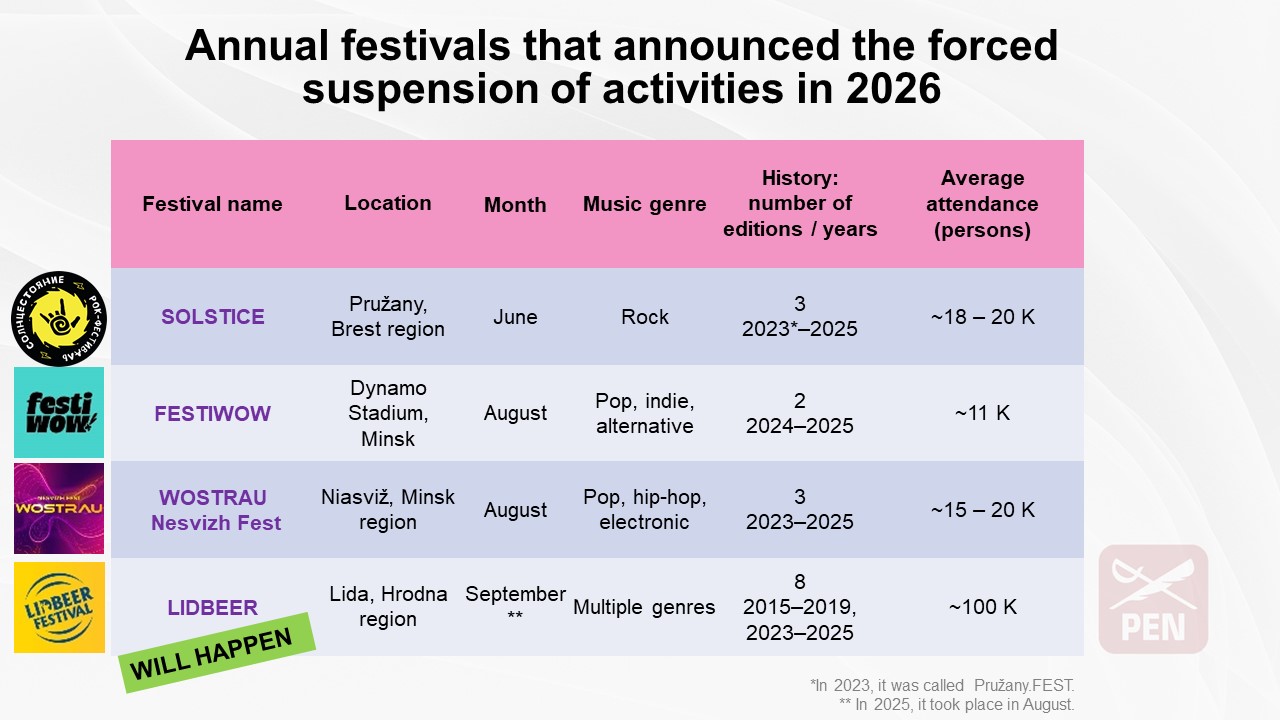
Below is a brief overview of festivals cancelled in 2026 and the estimated audiences affected by the loss of these established cultural events.
- The Solstice rock festival (Soncastajannie) was held in Pružany, Brest region, at the Muchaviec Stadium. The festival began in 2023 under the name Pružany.FEST as part of celebrations marking the city’s 590th anniversary. By 2024, it had acquired its official name, become a ticketed event, and moved to late June. Three editions took place in total. In its second year, attendance exceeded the town’s population (approximately 19,000 people). On 8 December 2025, organisers announced that the festival would not take place in 2026.
“The organising company had not been included in the state register of cultural and entertainment events and therefore had no right to organise performances by foreign (including Russian) artists”.
- Wostrau Nesvizh Fest, held on the grounds of the Niasviž National Historical and Cultural Museum-Reserve, took place near a 16th-century UNESCO World Heritage Site. The open-air festival had been organised annually since 2023 and attracted between 15,000 and 25,000 visitors per weekend. On 5 February, organisers announced the cancellation, thanking audiences, partners, and staff for their support over the years.
“A big thank you to the town of Niasviž – for its beauty, vibe, and warm welcome. Thanks to our partners, contractors, and the entire team for your tremendous work and belief in the project. And most importantly, thank YOU, our guests, for your trust, your love, and for creating WOSTRAU together with us throughout all these years”.
- LIDBEER – an annual festival held in the town of Lida since 2015 as a social project of the Lidskaje Piva brewery company. Admission to most venues across the city was traditionally free. The event, timed to coincide with City Day celebrations, was usually held in early September, with the main stage located near the walls of Lida Castle – another site included in the State List of Historical and Cultural Values of the Republic of Belarus. Over its existence, the festival was held 8 times, evolving from a rock open-air event into a large-scale multi-genre celebration. In its peak years (2018–2019), attendance exceeded 130,000 visitors. This year, Lidskaje Piva marks its 150th anniversary; however, on 19 March, it became known that this event, too, had been cancelled:
“It is with sadness and regret that we announce that the LIDBEER festival will not take place this year”.
[On 28 April, information emerged indicating that the festival would nevertheless go ahead.]
- FESTIWOW – the newest festival on the list – was held at Minsk’s Dynamo Stadium in 2024 and 2025 and focused on contemporary pop, indie, and alternative music. Average attendance reached approximately 11,000 people. On 30 March, organisers announced its cancellation “for reasons beyond our control”:
“This came as a major blow to us, as we had already signed contracts with artists, concluded agreements with partners, planned to announce the headliners, and launch ticket sales. Until the very last moment, we believed we would receive permission to hold our festival, but unfortunately, the law is the law”.
Comments under cancellation announcements across social media reflected widespread disappointment among audiences: many had planned family trips and looked forward to annual traditions and favourite events. Nevertheless, thousands of Belarusians have effectively been deprived of the opportunity to enjoy cultural life in familiar and accessible formats.
CRIMINAL PROSECUTION AND NATIONALISATION AS TOTAL CENSORSHIP TOOLS
The cancellation of festivals, bans on performers, and restrictions on book distribution represent only part of a broader system of censorship in Belarus. Today, censorship permeates virtually all spheres of art, culture, and education – from the removal of artworks from exhibitions and the ideological vetting of tour guides to the outright criminalisation of cultural activity itself (see, for example, the sections on the persecution of independent publishers, the designation of cultural organisations as “extremist formations”, and criminal convictions related to artistic expression). Judicial mechanisms are increasingly used to dismantle independent cultural spaces, while economic pressure serves to execute the forced nationalisation and monopolisation of the cultural sphere.
Examples documented during the reporting period include:
- Closure of creative spaces and venues. Following a raid by security forces, the Minsk cultural space Parason ceased operations (its social media accounts have not been updated since February). After the detention of its owner, the Belarusian book portal Knihi.by was blocked and designated “extremist”, with a notice appearing on the website stating: “The bookstore is not operating”.
- Persecution for historical education. The Prosecutor General’s Office initiated criminal proceedings against presenter Kaciaryna Vadanosava for her “authorial interpretation of historical events”. Her lectures on YouTube were deemed “rehabilitation of Nazism” under Article 130-1 (part 3) of the Criminal Code.
- Confiscation of manuscripts. Cases continue to be documented in which manuscripts, diaries, and personal notes are confiscated from political prisoners upon their release, preventing their ideas and writings from leaving prison walls.
- Nationalisation through economic pressure. A striking example of the displacement of independent actors from the cultural sphere is the case of Kvitki.by, the country’s largest ticketing operator. Following the detention of the company’s management in August 2025, liquidation proceedings began in September. In January 2026, it became known that the service’s trademarks had been transferred to the state enterprise Belarusian Lotteries, which operates under the Administration of the president. In this way, the state acquired direct control over significant financial flows and infrastructure linked to cultural events.
- Other cases of direct and indirect censorship and violations of cultural rights, including non-public incidents.
STATE POLICY IN THE FIELD OF CULTURE
The current trajectory of the state’s cultural policy shows no change, continuing to prioritise censorship and stricter control, the marginalisation of dissent alongside in favour of loyalists, the militarisation of the cultural landscape, the monopolisation of historical memory discourse, and a firm anti-Western and pro-Russian stance. The following section explores key dimensions of cultural policy throughout the reporting timeframe, including new legislative measures.
State programme “Cultural Landscape” for 2026–2030
At a meeting of the Ministry of Culture board entitled “On the Results of the Cultural Sector in 2025 and Development Tasks for 2026”, then Minister of Culture Rusłan Čarniecki spoke in distinctly Soviet-style terms about culture as an instrument of the “spiritual and moral education of generations”. Among the key developments, he highlighted the adoption of Council of Ministers Resolution No. 454, which strengthened state control through the register of organisers of cultural events and has already led to the cancellation of several major music festivals. One of the principal problems identified was a shortage of human resources, reflected in the large number of long-standing vacancies at the mid-level of the sector.
The minister declared the completion of the new National History Museum building as one of the main priorities for 2026 – a vast ideological construction project intended to present an officially curated and heavily filtered interpretation of the past. Continued funding for this project is enshrined in the State Programme “Cultural Landscape” for 2026–2030, which entered into force on 1 January 2026.
Overall, the new state programme represents a classic example of centrally planned governance, in which the development of the sector is measured primarily through quantitative indicators such as the number of exhibitions, events, visitors, and similar metrics. Against this backdrop, official declarations about “ensuring access to art” or “deepening the integration of Belarusian culture into the global cultural space” appear purely formal, detached from reality. In the current context of mass repression against cultural figures and Belarus’s deep international isolation, attempts to speak of “global integration” only underscore the gulf between bureaucratic planning and the actual situation on the ground.
This contradiction is clearly visible in plans to modernise libraries and rural cultural centres while simultaneously confiscating “undesirable” literature under the supervision of security structures. A similar selectivity will affect the digitisation of museum catalogues: under Directive No. 12 “On the Implementation of the Foundations of the Ideology of the Belarusian State”, adopted in 2025, digitisation will apply only to objects that have passed ideological filtering. At the same time, the programme entirely excludes support for independent initiatives and grassroots cultural movements. Amid the systematic destruction of independent cultural activity, anything falling outside the vertical structure of the Ministry of Culture remains excluded from both funding and the legal field.
This tendency characterises the state programme for 2026–2030 as a whole: emphasis on superficial modernisation and façade renovation serves to conceal a deep staffing crisis and the replacement of genuine cultural life with sterile ideological form.
Possible reorganisation of Jakub Kołas and Janka Kupała Museums
A further alarming signal is the Ministry of Culture’s initiative to reorganise the museums dedicated to Belarusian literary classics Jakub Kołas and Janka Kupała. The proposal reportedly involves stripping these institutions of their independent status. The professional community has reacted sharply negatively to these plans, fearing that such “optimisation” would inflict irreparable damage on the scholarly, educational, and exhibition activities of both museums.
Draft law on the use of music without authors’ consent
On 11 February, deputies adopted in first reading a draft law “On Amendments to Legislation on the Legal Protection of Intellectual Property Objects”. The document introduces the possibility for television media outlets included in the mandatory publicly accessible broadcasting package to use musical works without the consent of rights holders, provided remuneration is paid.
In practice, this amounts to a restriction on property rights. The key issue lies not merely in the absence of consent, but in the loss of authors’ control over context: music may be used in propaganda content without the creator being able to influence or prevent such use.
This development appears particularly revealing in light of the new status granted to the television channel VoenTV. From 23 February 2026, this military broadcaster – whose programming is centred on “patriotic content and cinema” – became an independent broadcasting platform and was included in the mandatory public package.
New appointment at the Janka Kupała National Academic Theatre
On 10 March 2026, the theatre company was introduced to its new artistic director, Russian theatre director Dmitry Akimov, who had previously worked with the troupe as a guest director. The Ministry of Culture officially presented the appointment as the beginning of a “new chapter” in the history of the country’s flagship theatre.
However, the decision was met with considerable scepticism within the professional community. Experts viewed the appointment of a foreign director as undermining Belarusian theatrical traditions and the institutional legacy of the Kupała Theatre. Critics argued that a person external to Belarusian culture – someone unfamiliar with the Belarusian language and not integrated into the country’s cultural context and national realities – cannot meaningfully lead the country’s principal stage.
The appointment became a logical consequence of the systemic human resources crisis that emerged after the events of 2020, when most of the theatre’s troupe resigned. In the years since, the management has failed to restore the theatre’s creative potential. As many Belarusian actors refused to cooperate with the institution, the theatre became increasingly dependent on external appointments.
CONCLUSIONS
Between January and March 2026, 335 violations of cultural rights and human rights of cultural figures were documented in Belarus, including arrests, criminal prosecution, torture in places of detention, forced expulsion from the country, transnational repression, numerous manifestations of censorship, and other forms of persecution. The March pardon of more than two dozen cultural figures did not alter the systemic nature of the crackdown, as the releases took place simultaneously with new waves of detentions.
The systematic persecution of the cultural sphere has led to a situation in which, even at the official level, the authorities have been forced to acknowledge an acute staffing crisis following the results of 2025. According to the Ministry of Culture’s own report, “the country today lacks librarians, performers, directors, and leaders of creative collectives”. This personnel shortage is a direct consequence of the policy of purges and the forced emigration of professionals.
As of the end of March, at least 128 representatives of the cultural sphere remained imprisoned or subjected to restrictions on liberty. Notably, during the officially proclaimed “Year of the Belarusian Woman”, at least 47 female cultural figures were serving politically motivated sentences either behind bars or in home confinement.
The independent cultural sector continues to face increasing criminalisation, while literature, Belarusian-language publishing, and initiatives built around the national language remain priority targets. Through the use of “extremist formation” designations, the state is monopolising the cultural sphere, effectively equating independent artistic expression with criminal conduct and creating conditions for the near-total isolation of the domestic cultural environment.
The criminalisation of culture, together with discrimination against the Belarusian language, forms part of a broader systemic policy aimed at undermining Belarusian national identity. Human rights organisations, including PEN International, have called for the immediate cessation of the use of “anti-extremism” legislation to suppress freedom of expression and have urged the international community to continue supporting the Belarusian language and culture both within Belarus and abroad.
[1] The information regarding the number of cultural figures affected is not exhaustive, as details about some individuals do not become known immediately.
[2] Between June 2025 and March 2026, four waves of pardons took place following visits by John Coale to Minsk and with the mediation of the United States government. As a result, 439 individuals were released, including 48 cultural figures.
[3] For some cultural figures, human rights defenders do not yet have confirmation that the individuals included in the published pardon lists have, in fact, been released.
[4] The practice of recognising individuals whose persecution became known only after their release as “former political prisoners”.
[5] https://budzma.org/about/.
[6] https://gutenbergpublisher.eu/en/publisher/.
[7] /en/pen.html/.
[8] https://kamunikat.org/about.
[9] https://knihauka.com/pl/i/O-firmie/8.
[10] https://instagram.com/spadcyna_belarusi?igshid=YmMyMTA2M2Y=.
[11] https://www.en.northernlightsff.com/.
[12] Uładzimir Patapienka was among those pardoned in March 2026.