
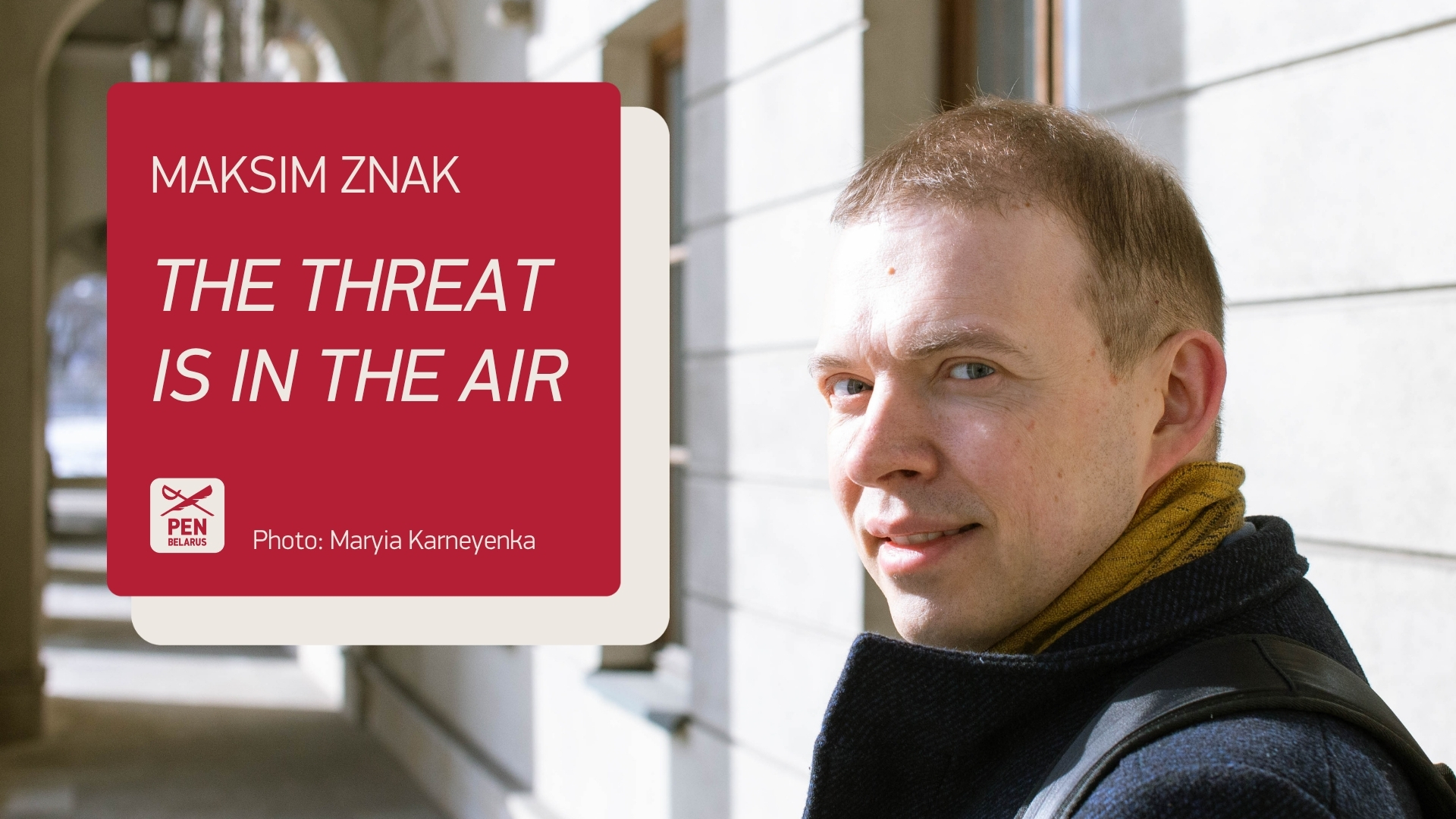
Adapted version of the speech delivered at the Ninth World Congress Against the Death Penalty (Belarusian side event).
Paris, 2 July 2026
I have the rather sad honour of showing the participants of the World Congress Against the Death Penalty what the situation with this “exceptional measure” looks like in Belarus. Our jurisdiction is a special case. Of course, everyone attending this Congress is familiar with the legal context and the universal facts about capital punishment. But in Belarus, the death penalty is surrounded by a unique and dark atmosphere — one rooted in history, yet very much present today, particularly in the context of the events of 2020 and the war in Ukraine.
I want to share my personal experience of dealing with what is now called the “justice system” in Belarus, and explain how the existence of the death penalty leaves its mark on that system.
My name is Maksim Znak. I have always been a lawyer. I taught law and was the managing partner of a law firm. During the 2020 presidential election, I was responsible for legal affairs at the United Opposition Headquarters and served as a lawyer for opposition leaders Viktor Babariko, Sviatlana Tsikhanouskaya, and Maria Kalesnikava. Maria and I became co-defendants in the same criminal case. We sat together in the same glass cage in the courtroom and received our sentences together: ten years for me, eleven for her. To this day, we still do not know which of our actions were considered a “conspiracy”. No explanation was ever given to us. The authorities failed to formulate the charges properly, but the trial was held behind closed doors, and no one seemed particularly concerned. A secret within a secret. In the end, I was convicted, recognised as a prisoner of conscience, and spent more than five years behind bars. Many of my friends are still there, experiencing exactly what I am about to describe.
One of the first things I saw after my release was a link someone sent me. It led to the website of the British publisher of my book. In fact, the article is still online — I took a screenshot just yesterday. The headline reads: “Scots publisher celebrates release of political prisoner ‘everyone thought was dead’.”
You know, it is not generally customary to assume that someone is dead simply because they have been sentenced to ten years in prison. Usually, you assume they are simply in prison. But here, people were celebrating the very fact that I was alive. And while that was incredibly sweet and heartfelt, it inevitably made me wonder: why was such a grim possibility being considered in the first place? Of course, I had been held incommunicado for almost three years — without letters, phone calls, or visits from lawyers. My family and the outside world genuinely had no information about my condition. But to assume that I was dead — that is a very serious matter.
If we look at our Constitution — the one adopted in 1994 — the death penalty is described as an exceptional measure that should eventually be abolished. This is written in the country’s supreme law. Yet it is perfectly clear that we are moving in the opposite direction. We are not abolishing capital punishment. On the contrary, we are increasing the number of capital offences, extending the scope of the death penalty even to attempted crimes that do not involve murder. We will discuss shortly why this is happening.
…A round white tower with battlements, right in the centre of Minsk. My personal encounter with this system began at the so-called Pischalovsky Castle. In reality, it was never a castle. It has always been a prison, built by the Russian Empire back in the nineteenth century. Many historical figures — Belarusians we read about in our textbooks — were imprisoned there, and many were executed within its walls. Our history was quite literally written by people who were thrown behind bars and shot.
This place, known as Volodarka or Detention Centre No. 1, has preserved a very particular, oppressive atmosphere. A dark vaulted corridor, peeling walls, a solitary light bulb hanging from the ceiling… This is what we saw every day as we were taken out for exercise in the small prison yard. The building looks as though it had been deliberately designed for executions. Like a scene straight out of a movie. You feel the back of your head tense up, waiting for something to come flying out of the darkness. And you wait — because almost from their very first day, all prisoners know the legends.
None of us had been sentenced to death — the charges against us did not even carry that possibility — yet stories about death were constantly with us. From your very first days in the institution, you are fed accounts of executions: how they lead you down those corridors, how you never know whether you are being taken for an ordinary walk or on your final journey… You will not realise what is happening until it is too late. The stories are told in such detail that you might think the people telling them had experienced it themselves. You hear them not only from your cellmates but also from the guards, who may even joke about it. Frankly, there is nothing funny about it when you are locked up in there. The atmosphere is hardly conducive to amusement.
The problem with the death penalty in Belarus is not only that it exists, but also that the procedure itself amounts to psychological torture. The law stipulates that a person sentenced to death is not informed when the execution will take place. They are never warned in advance. They simply wait, and that waiting may be long or short. They cannot prepare. They cannot say goodbye. Moreover, the burial location and the details of the execution are treated as top state secrets. Relatives are informed only after the sentence has been carried out. And they are never told where their loved one is buried.
Having recalled the beginning of my imprisonment, I also want to remember one of the happiest moments of my life: 13 December 2025, the day of my release. I step off the bus and embrace Maria Kalesnikava and Viktor Babariko. We have just been told that we are free. Only half an hour earlier, we were still human cargo being delivered under the terms of a deal.
Throughout that day, beginning in the middle of the night, we had been transported from our respective penal colonies and prisons towards Ukraine. Black hoods were pulled over our heads, our eyes were wrapped with tape, and our hands were handcuffed behind our backs — and later bound with adhesive tape. I knew about the political negotiations with the United States, so I was expecting to be released. But some of the people on the bus were simply told by the guards that they were being taken into the forest to be shot. It sounded terrifyingly plausible. When you have spent fourteen hours sitting in a small bus, blindfolded and with your hands bound, you can believe just about anything — until you are finally allowed to take the hood off your head.
When the threat of the death penalty hangs constantly in the air, it becomes a weapon that can be pointed in any direction. The authorities actively use it to maintain an atmosphere of terror and lawlessness in every possible situation. In the past, capital punishment was reserved for intentional murder. Now, “treason against the state”, “terrorism” — interpreted in the broadest possible sense — and even attempts to commit such offences have been added.
It is precisely this political and anti-terrorism dimension that is driving the expansion of capital offences. New bogeymen are introduced to intimidate, for example, government officials and members of the military. And unfortunately, any one of these threats can become a reality at any moment. There has already been a precedent of a death sentence imposed on a foreign national for an attempted offence. What will they come up with next?
A small barred window set into a deep blue wall. The cell resembles a coffin, widening towards the window. All the cells radiate outwards from the centre, like the petals of a daisy. This is another place where you encounter a grim historical tradition: the KGB detention centre known as Amerikanka. A circular prison, a panopticon designed so that all its cells can be observed from a single central point. I spent only a short time in this institution during my journey through the prison system, but it left a deep impression on me, because every detail of the place seemed to evoke its history.
Many horrific things have happened here, both in the past and in the present. Every Belarusian with even a passing interest in our history knows about the terrible chapter of Stalin’s purges. In a single night, on 29 October 1937, dozens of Belarus’s most brilliant writers, poets, and intellectuals were executed.
More than 130 people — cultural figures who had contributed to shaping our national identity — were shot right in the basement of Amerikanka. Just a few days earlier, an auto-da-fé, a death by fire, had taken place in the prison courtyard: their manuscripts were burned.
For me, this is personal in two ways. Before my eyes is a photograph of a beaten man, with a weary gaze and a familiar face — although we never had the chance to meet. This is my great-grandfather, Aliaksandr, my father’s grandfather. He was not executed on the night of 29 October 1937. He was shot three days later. In those years, quotas were issued specifying exactly how many people had to be executed in each region. We still do not know where they were buried. But there is a strong possibility that it was somewhere very close to Minsk.
Wooden crosses among the trees of a snow-covered forest, a sombre cemetery without dates or names… Kurapaty, the best-known site of mass graves from that era. The crosses were erected by volunteers. To this day, the state refuses to officially acknowledge these burial sites of innocent people who were murdered and later rehabilitated. These and other burial grounds remain shrouded in secrecy.
I must remind you that we are talking about a country located in the geographical centre of Europe. And yet Belarus, despite all the historical events I have mentioned, is the only country in Europe that still carries out death sentences, and the only former Soviet republic where capital punishment remains in force. A grim distinction.
In 1937–1938, there was an official execution plan: 7,500 people were to be shot. Around 7,000 were indeed executed, while countless others died under torture during the investigation or took their own lives. This is our history. Every country has dark chapters in its past, but the problem is how closely that past is reflected in our present. I have personally read the NKVD interrogation transcripts of my great-grandfather, and the resemblance to what is happening today is terrifying.
My stay at Amerikanka was brief. I was brought there for the famous meeting between Lukashenka and the prisoners. It was a kind of round-table discussion to which every participant except one was brought in handcuffs, face down on the floor. The next day, we were granted a royal favour: without warning, we were taken to a “bathhouse” in the forest. The silent movements and transfers, the dark lines of armed guards in balaclavas surrounding the buildings — it all resembled scenes from films about occupied territories.
After my sentencing, my journey continued. I was transferred to a penal colony in Vitebsk. For a while, I lived in a communal barracks with other prisoners, before being moved to concrete solitary confinement cells. This place, too, had witnessed one of the tragic stories associated with the death penalty. We have so many such stories that practically any “correctional” institution you point to will have one.
It was at Vitba that one of the investigators involved in certain episodes of the infamous “Vitebsk Case” served his sentence. The prison library contains a book he wrote in which he attempts to explain how that horrific case could have happened. A serial killer named Mikhasevich murdered women between 1971 and 1985. He confessed to 43 murders, 36 of which were proven by investigators. But there were another 14 victims — this time, victims of the investigators themselves.
Fourteen innocent people were accused, at different times, of crimes committed by Mikhasevich. They were tortured into confessing, and one of them, Terenia, was executed. It was a double tragedy: first, the horrific crimes of the murderer, and then the irreversible crime of the state. And that can never be undone or put right, because a human being was killed. The rehabilitation certificates later issued to the families of Stalinist repression victims did not bring their murdered loved ones back either.
The risk of irreversible consequences can also be expressed in numbers. First, you should know that more than 400 people have been executed in Belarus since 1991. Now imagine that you are a defence lawyer and take a look at the official statistics published on the Supreme Court’s website. They are simply horrifying: the acquittal rate is around 0.1 per cent.
That means only one in every thousand people who stand trial will be found not guilty. Out of a thousand defendants, perhaps one will walk free. When someone faces the death penalty in a system with statistics like these, they will almost certainly be executed. I refuse to believe that our judicial system makes a mistake only once in every thousand cases. Human beings make mistakes far more often than that. This is precisely why judicial safeguards are essential — to protect against irreversible consequences. At the absolute minimum, the state should not kill the people it convicts.
To conclude my speech and give you a clear sense of the atmosphere in the country before the other panellists delve into recent legal changes, public education, and what democratic forces in exile can do, I want to share two brief stories. They come from a slightly different world, and they show that the problem goes far deeper than a few lines in the Criminal Code. It is about a mindset that has been shaped over centuries.
Grey walls, a metal grid instead of the sky, trampled snow on the concrete floor. This is one of the prison exercise yards. Interesting conversations take place during walks in yards like these, or in the asphalt-covered exercise areas of the prison’s segregated sections.
At the Vitebsk penal colony, I met many people convicted of murder. Two of them, entirely independently and at different times, told me exactly the same thing. Both had been sentenced to 25 years in prison — the maximum fixed-term prison sentence permitted by law. Both told me that the families and friends of their victims had formed active public groups and were campaigning relentlessly to have their sentences changed to death. Society was not satisfied with a 25-year sentence. They were doing everything they could to have the murderer executed.
The prisoners spoke about these campaigns with a strange mixture of shock, pride, and deep fear. It must be profoundly unsettling to know that somewhere out there, hundreds or thousands of people are actively wishing for your death. But this public thirst for revenge is part of our reality, and we have to acknowledge it.
I want to tell you one more story, indirectly related to the death penalty. It happened when I was already being held permanently in the punishment isolation unit and the cell-type premises.
A punishment isolation cell is hardly a holiday resort. At night, you are given neither a mattress nor a blanket. It can get so cold in those cells that you have to wake up several times during the night and do push-ups to warm yourself up enough to get a little more sleep — until your next fitness session.
In the cell-type unit, I had a similar conversation with several prisoners. They were not political prisoners, but they too had endured between 40 and 90 days in punishment isolation. All of them were simply obsessed with Anders Breivik, the Norwegian mass murderer. Belarusian state propaganda loves producing stories about Breivik to demonstrate how “strange and inhumane” Europe supposedly is: instead of executing a monster, Westerners keep him in comfortable conditions.
These prisoners — even those convicted of murder themselves! — were genuinely outraged.
“How can the European Union treat a murderer like that? He should be dead! Or at least he should be living in conditions like ours: without a blanket, without a mattress, without a jacuzzi or the internet.”
I asked every one of them the same question:
“Listen, you do understand that these are simply the standard conditions in their prison system. It’s a package deal: either all of us, as prisoners, have decent living conditions, or none of us do. What would you choose? To live in a prison system with conditions like his, or to have him brought down to live in conditions like ours? Which is better: improving the lives of thousands of people locked up in our prisons, or making sure that he suffers too?”
When you are sitting in solitary confinement, you take questions like that very seriously. They would stop talking and think long and hard. And every single one of them would eventually look at me and say:
“You know what? Let them bring him here. We’ll keep suffering, as long as we know that he is suffering right alongside us.”
This deeply ingrained and heightened understanding of revenge as an expression of justice is another obstacle to efforts to abolish the death penalty. It is an essential part of the picture if we want to truly understand the situation in Belarus and move towards the clearly stated goal enshrined in both the original and the latest versions of our Constitution. The abolition of the death penalty.