Why are books banned in Belarus, who assesses their “harmfulness,” and how does the censorship mechanism work overall? We do not have clear answers to these questions. A distinctive feature of the Belarusian situation is the absence of any coherent explanation from the repressive authorities. Books are removed from libraries, bookshops, and school curricula — and with them, vital ideas about language, history, and freedom are erased.
Our task is to bring these “forbidden” books into the light and to speak about them. Because the word continues to live as long as there are those who want to read it.
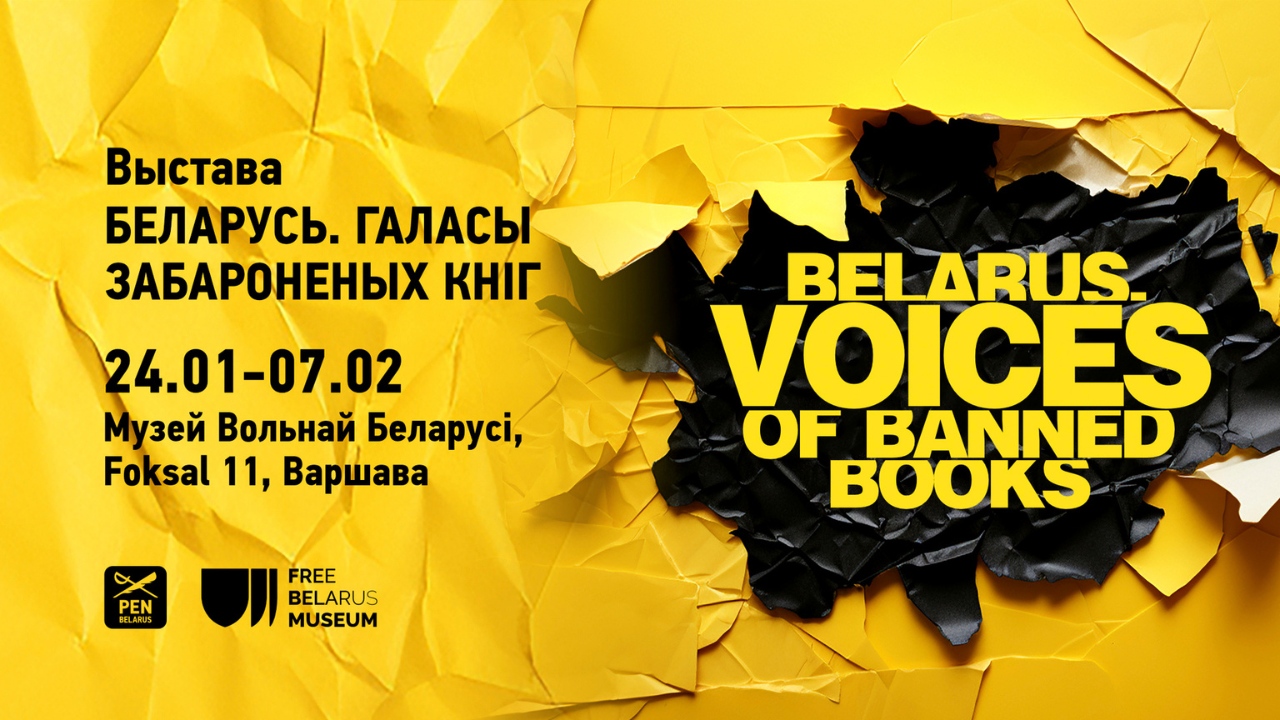
PEN Belarus invites you to an exhibition dedicated to books banned in Belarus.
We have collected several stories of authors and their works that the state has sentenced as “extremist,” “harmful to national interests,” or “undesirable information.” Listen to the voices of books that are destined to be silenced in our country, leaf through their pages, and do not allow censorship to prevail in our shared struggle for free expression.
The exhibition will run from January 24 to February 7 in Warsaw, at the Free Belarus Museum (Foksal 11).
Exhibition opening hours:
Tuesday–Friday: 4:00–8:00 pm
Saturday–Sunday: 12:00–8:00 pm
The project was presented in early autumn in Kraków at the 91st Congress of International PEN, and in November in Gdańsk during the Giedroyc Prize award ceremony.
Poet and head of PEN Belarus Taciana Niadbaj:
“The books gathered here differ enormously – by genre, theme, geography, and by the depth of human experience they contain. Yet they share one defining quality: a refusal to accept the worldview of a totalitarian state. They show other models of life, alternative versions of reality. Their authors place no limits on thought or emotion – and that is precisely what makes them dangerous.
Real literature does not obey power. It listens to life, catches its breath, and in doing so both reflects and shapes a new social order. It does not serve – and that, in the eyes of a dictatorship, is its unforgivable crime.”
In today’s hyper-vigilant bureaucratic optics, even our first printer, Skaryna, would be suspected of “dangerous” passages. And how many “delayed-action mines” do the ideologues detect in Kupała, Arsiennieva, Łastoŭski, Niaklajeŭ, Bacharevič, Sieviaryniec… in our classics, in living authors, in writers from abroad?
In a country where truth is treated as a threat and service to people is deemed suspicious, the words of free creators sound like defiance – grounds for prohibition. The real issue is not loyalty to the ruler, but responsibility to oneself and to Belarus.
History teaches us this: no censor has ever triumphed over the written word. A book can be burned, but its meaning cannot be destroyed. A thought can be imprisoned, but it cannot be made to disappear. This is why literature endures as the strongest form of freedom – stronger than any regime.”
Today in Belarus:
311+ books banned for political or ideological reasons
256+ authors under prohibition
5 independent publishers liquidated in the past five years
At least 31 writers are behind bars
All information on banned books is collected and systematized on our website: bannedbooks.penbelarus.org/en